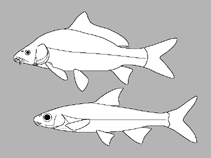
Classificazione / Nomi
Nomi Comuni | Sinonimi | Catalog of Fishes(Genere, Specie) | ITIS | CoL | WoRMS | Cloffa
>
Cypriniformes (Carps) >
Cyprinidae (Minnows or carps) > Labeoninae
Etymology: Garra: Name based on a vernacular Indian name (Hamilton, 1822:343, Ref. 1813); a fish living in mud (Ref. 128817); arunachalensis: Named for Arunachal Pradesh, the state where it is distributed; an adjective.
Ambiente: milieu / zona climatica / distribuzione batimetrica / gamma di distribuzione
Ecologia
; acqua dolce benthopelagico. Subtropical
Asia: India.
Dimensione / Peso / Età
Maturità: Lm ? range ? - ? cm
Max length : 12.6 cm SL maschio/sesso non determinato; (Ref. 94542)
Breve descrizione
Chiavi di identificazione | Morfologia | Morfometria
Vertebre: 33 - 34. This species is distinguished from its congeners in the Ganga-Brahmaputra by the following characters: snout morphology with a transverse lobe with 8-24 small- to medium-sized tubercles, distinct quadrate proboscis slightly tapering anteriorly and moderately elevated upwards, the anterior margin of the proboscis is truncate and sharply delineated from the depressed rostral surface by a narrow transverse groove, each anterolateral marginal corner of the proboscis have one large unicuspid, acanthoid tubercle, and one small tubercle in between, and the lateral margin of the proboscis with 3-6 small tubercles in one row; differs from G. birostris, G. quadratirostris, G. gotyla in lacking (vs. having) an anterolateral lobe of the lower lip, a more posteriorly situated anus (distance from anus to anal fin 19-25 % of pelvic-anal distance vs. 22-44), by the number of lateral-line scales 35 (vs. 33-34; except in G. quadratirostris). it has fewer transverse scale rows between lateral line and anal-fin origin 3 1/2 (vs. 4-4 1/2), with circumpeduncular scale rows 12 (vs. 16), has a larger adhesive disc with disc length 45-53 % HL (vs. 33-42), central callous-pad width 39-48 % HL (vs. 30-41), and length 32-38 % HL (vs. 20-28), without (vs. with) a black spot at the upper angle of the gill opening; differs from G. quadratirostris in having fewer lateral-line scales 35 (vs. 37), total vertebrae 33-34 (vs. 35-36),
abdominal vertebrae 15-16 (vs. 17-18), and predorsal vertebrae 9 (vs. 10-11) (Ref. 94542); differs from Garra nethravathiensis by having the following characters: unbranched dorsal-fin rays 3 (vs.2); unbranched anal-fin rays 3 (vs. 2); branched pectoral-fin rays 14-15 (13); pre-dorsal scales 10-12 (vs. 8-10); lateral-line scales 35 (vs. 30-31); scales between lateral line to origin of pelvic-fin 3.5 (2.5); circumpeduncular scales 12 (vs. 16) (Ref. 96640).
Body shape (shape guide): elongated; Cross section: oval.
Ciclo vitale e comportamento di accoppiamento
Maturità | Riproduzione | Deposizione | Uova | Fecondità | Larve
Nebeshwar, K. and W. Vishwanath, 2013. Three new species of Garra (Pisces: Cyprinidae) from north-eastern India and redescription of G. gotyla. Ichthyol. Explor. Freshwat. 24(2):97-120. (Ref. 94542)
Stato della Lista Rossa IUCN (Ref. 130435: Version 2025-2 (Global))
Minaccia per l'uomo
Harmless
Usi umani
Pesca: di nessun interesse
Strumenti
Rapporti speciali
Scarica XML
Fonti Internet
Stime basate su modelli
Indice di diversità filogenetica (Fonte Biblio.
82804): PD
50 = 0.5000 [Uniqueness, from 0.5 = low to 2.0 = high].
Bayesian length-weight: a=0.00794 (0.00359 - 0.01758), b=3.04 (2.87 - 3.21), in cm total length, based on LWR estimates for this Genus-body shape (Ref.
93245).
Resilienza (Fonte Biblio.
120179): Alto, tempo minimo di raddoppiamento della popolazione meno di 15 mesi (Preliminary K or Fecundity.).
Vulnerabilità della pesca (Ref.
59153): Low vulnerability (10 of 100).
🛈