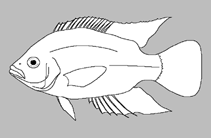
Classification / Noms
Noms communs | Synonymes | Catalog of Fishes(Genre, Espèce) | ITIS | CoL | WoRMS | Cloffa
>
Cichliformes (Cichlids, convict blennies) >
Cichlidae (Cichlids) > Pseudocrenilabrinae
Etymology: Chalinochromis: Greek, chalina = bit, bridle + Greek, chromis = a fish, perhaps a perch (Ref. 45335); cyanophleps: The specific name, cyanophleps, is a Greek adjective meaning blue-veined, with reference to the conspicuous blue stripe below the eye (Ref. 95611).
Environnement : milieu / zone climatique / profondeur / gamme de distribution
Écologie
; eau douce benthopélagique; profondeur 6 - 45 m (Ref. 95611). Tropical
Africa: Lake Tanganyika, along the Tanzanian coast from Mvuna Island south to Kalala Island (Ref. 95611).
Taille / Poids / Âge
Maturité: Lm ? range ? - ? cm
Max length : 12.9 cm SL mâle / non sexé; (Ref. 95611)
Description synthétique
Clés d'identification | Morphologie | Morphométrie
Épines dorsales (Total) : 22 - 23; Rayons mous dorsaux (Total) : 7 - 8; Épines anales: 6 - 7; Rayons mous anaux: 6 - 7; Vertèbres: 35 - 36. Diagnosis: Chalinochromis cyanophleps is distinguished from C. brichardi by flank colour brown to dark grey vs. beige or light grey; dark brown stripe below eye vs. contrasting black vertical stripes on head; iris and eye ring partly orange vs. orange colour not or faintly visible; opercular blotch absent vs. prominent; black blotch posteriorly in dorsal fin absent vs. present; dorsal and caudal fins dark with white dots vs. pale and dots absent; black spot at pectoral-fin base absent vs. present; more teeth in upper jaw, 13-16 vs. 5-10 in hemiseries, and lower jaw, 17-26 vs. 2-3 in hemiseries; and slender caudal peduncle, its depth 9.9-10.7% of standard length vs. 11.6-12.4% (Ref. 95611). It is distinguished from all other species of Chalinochromis by absence of stripes and blotches on head; lips not folded over adjacent jaw and not callous or papillate on lip surface outside that close to teeth vs. lips wide and folded over adjacent premaxilla and dentary, and more or less extensively papillose on abroad surfaces; presence of tricuspid inner teeth vs. exclusively unicuspid; and five mandibular lateralis foramina vs. four (Ref. 95611). It is distinguished from all species of Altolamprologus, Lamprologus, Lepidiolamprologus, Neolamprologus, Paleolamprologus and Variabilichromis by number of dorsal-fin spines, 22-23 vs. 14-21; from all species of Congo River Lamprologus by first pelvic-fin ray longest vs. second to third rays longest, and lateral line scales 37-39 vs. 29-37; from all species of Telmatochromis by dentition, inner teeth mostly unicuspid vs. only or predominantly tricuspid, posterodorsal corner of opercle rounded vs. pointed, and upper jaw projecting vs. jaws equal; from all species of Julidochromis by absence of bars and bands on body, and scales in longitudinal row 37-39 vs. 36 or less (Ref. 95611).
Body shape (shape guide): elongated.
This species is a cryptic, timorous fish occupying rocky areas with large rocks or boulders (Ref. 95611). It is very rarely seen in open areas, but can be found in the darker parts of its biotope, in dark crevices and caves (Ref. 95611).
Cycle de vie et comportement reproducteur
Maturité | Reproduction | Frai | Œufs | Fécondité | Larves
Kullander, S.O., M. Karlsson, M. Karlsson and M. Norén, 2014. Chalinochromis cyanophleps, a new species of cichlid fish (Teleostei: Cichlidae) from Lake Tanganyika. Zootaxa 3790(3):425-438. (Ref. 95611)
Statut dans la liste rouge de l'IUCN (Ref. 130435: Version 2025-2 (Global))
Menace pour l'homme
Harmless
Utilisations par l'homme
Pêcheries: sans intérêt
Outils
Articles particuliers
Télécharger en XML
Sources Internet
Estimations basées sur des modèles
Indice de diversité phylogénétique (Réf.
82804): PD
50 = 0.6250 [Uniqueness, from 0.5 = low to 2.0 = high].
Bayesian length-weight: a=0.01445 (0.00671 - 0.03113), b=2.99 (2.82 - 3.16), in cm total length, based on LWR estimates for this (Sub)family-body shape (Ref.
93245).
Niveau trophique (Réf.
69278): 3.5 ±0.4 se; based on size and trophs of closest relatives
Résilience (Réf.
120179): Haut, temps minimum de doublement de population inférieur à 15 mois (Preliminary K or Fecundity.).
Vulnérabilité de la pêche (Ref.
59153): Low vulnerability (10 of 100).
🛈