Classificatie / Namen
Lokale namen | Synoniemen | Catalog of Fishes(Genus, Soort(en)) | ITIS | CoL | WoRMS | Cloffa
Elasmobranchii (haaien en roggen) (sharks and rays) >
Carcharhiniformes (Ground sharks) >
Carcharhinidae (Requiem sharks)
Etymology: Carcharhinus: karcharos (Gr.), sharp or jagged; rhinus, an ancient name for sharks, from rhine (Gr.), rasp, both words alluding to a shark's jagged, rasp-like skin (See ETYFish); tjutjot: Indonesian word for shark (pronounced choo-choot) (See ETYFish).
Milieu: milieu / Klimaatzone / Diepte / verspreidingsgebied
Ecologie
marien rifbewoner; diepte ? - 100 m (Ref. 89954). Tropical
Western Pacific: from Indonesia and Taiwan, including Borneo but not Australia and New Guinea. Not confirmed west of the Indo-Malay Peninsula.
Lengte bij maturiteit / Grootte / Gewicht / Leeftijd
Maturiteit: Lm 77.4, range 76 - 79 cm
Max length : 93.7 cm TL mannelijk / geslacht onbekend; (Ref. 89954); 91.8 cm TL (female)
Korte beschrijving
Determinatiesleutels | Morfologie | Morfometrie
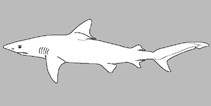
Wervels: 113 - 129. This small species is distinguished by the following characters: snout relatively long and bluntly pointed; upper anterior teeth are oblique and blade-like, coarsely serrated, lateral margin deeply notched and with several large and serrated basal cusplets; lower anterior teeth are narrower, slightly oblique, lateral margins notched and without large basal serrae, finely serrated; total tooth row counts 26-28/24-30 rows or 51-55; interdorsal space often with a moderate to strong ridge, 19.4-22.0% TL; first dorsal fin is relatively low, not falcate, origin over middle of pectoral-fin inner margin, length 14.1-15.6% TL, 1.4-2.0 times height, inner margin 2.0-2.7 in base; second dorsal fin is much smaller, broadly triangular, height 29-37% of first dorsal fin height, origin slightly posterior of anal-fin origin; anal fin is slightly falcate, height 0.9-1.3 times second dorsal-fin height, base 0.9-1.2 times second dorsal-fin base; body colour pale brownish dorsally, whitish ventrally; second dorsal fin with a black blotch on upper third of fin, not extending onto upper surface of body and very well defined from whitish region below; other fins are mostly plain; total vertebral counts 113-129; monospondylous precaudal counts 37-44; diplospondylous precaudal counts 17-19; diplospondylous caudal counts 58-72; precaudal counts 55-63 (Ref. 89954).
Body shape (shape guide): fusiform / normal.
An inshore species, likely to be found in less than 100 m depth (Ref. 89954). One female specimen contained 2 late-term embryos measuring 27.8 and 28.5 cm TL. Probable size at birth is between 34.0-38.0 cm TL (Ref. 89954).
Levenscyclus en paargedrag
Maturiteit | Voortplanting | Paaien | Eieren | Fecunditeit | Larven
White, W.T., 2012. A redescription of Carcharhinus dussumieri and C. sealei, with resurrection of C. coatesi and C. tjutjot as valid species (Chondrichthyes: Carcharhinidae). Zootaxa 3241:1-34. (Ref. 89954)
Status op de Rode Lijst van het IUCN (Ref. 130435: Version 2025-2 (Global))
Gevaar voor de mens
Harmless
Gebruik door de mens
Tools
Speciale rapporten
Download XML
Internetbronnen
Schattingen op basis van modellen
Fylogenetische diversiteitsindex (Ref.
82804): PD
50 = 0.5000 [Uniqueness, from 0.5 = low to 2.0 = high].
Bayesian length-weight: a=0.00525 (0.00244 - 0.01130), b=3.07 (2.90 - 3.24), in cm total length, based on LWR estimates for this Genus-body shape (Ref.
93245).
Trofisch niveau (Ref.
69278): 4.0 ±0.6 se; based on size and trophs of closest relatives
Weerstandsvermogen (Ref.
120179): laag, minimale populatieverdubbelingstijd 4,5-14 jaar (Preliminary low fecundity).
Kwetsbaarheid van de visserij (Ref.
59153): High vulnerability (57 of 100).
🛈