Elasmobranchi (squali e razze) (sharks and rays) >
Carcharhiniformes (Ground sharks) >
Carcharhinidae (Requiem sharks)
Etymology: Carcharhinus: karcharos (Gr.), sharp or jagged; rhinus, an ancient name for sharks, from rhine (Gr.), rasp, both words alluding to a shark's jagged, rasp-like skin (See ETYFish); humani: In honor of the late Brett A. Human (d. 2011), Australian marine biologist, Western Australian Museum (Perth), for “important contributions to shark taxonomy in South Africa and Oman in the western Indian Ocean region, and who is sorely missed by his colleagues” (See ETYFish).
Eponymy: Dr Brett A Human (1974–2011) was an Australian marine biologist and scientific diver at the Department of Aquatic Zoology, Western Australian Museum, Welshpool. [...] (Ref. 128868), visit book page.
Ambiente: milieu / zona climatica / distribuzione batimetrica / gamma di distribuzione
Ecologia
marino pelagic-neritic; distribuzione batimetrica 36 - 43 m (Ref. 96342). Tropical
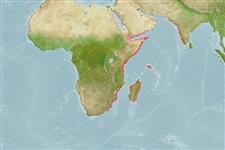
Western Indian Ocean: from Kuwait in the Persian (Arabian) Gulf, to Socotra Islands; south to Mozambique (Maputo Bay) and South Africa (Natal).
Dimensione / Peso / Età
Maturità: Lm ? range ? - ? cm
Max length : 84.4 cm TL maschio/sesso non determinato; (Ref. 96342)
Breve descrizione
Chiavi di identificazione | Morfologia | Morfometria
This species is distinguished by the following characters: moderately long and narrowly rounded snout; upper anterior teeth are oblique and blade-like, coarsely serrated, the lateral margin deeply notched and with several large, smooth basal cusplets; lower anterior teeth are narrower, slightly oblique, lateral margins notched and usually several smooth basal cusplets; total tooth row counts 24-26/22-25, or 46-50; a weak ridge usually present on midline of interdorsal space, 20.4-22.0% TL; moderately tall and slightly falcate first dorsal fin, its origin just anterior to pectoral-fin free rear tip, length 13.4-14.6% TL, 1.3-1.5 times height, inner margin 1.7-2.3 times in base; broadly triangular second dorsal fin, its height 39-48% of first dorsal-fin height, origin about opposite to anal-fin origin; anal fin falcate, height 0.8-1.0 times second dorsal height, base 0.9-1.2 times second dorsal-fin base; colour pale brownish to grey dorsally, whitish ventrally; second dorsal fin with a black blotch on upper one to two thirds of fin, not extending onto upper surface of body and strongly demarcated from ground colour; most other fins have whitish outer margins; total vertebral counts 153-160 in 4 type specimens (Ref. 6184:152-167); precaudal counts 75-79 (Ref. 6184:74-85); precaudal counts - monospondylous 45-48, diplospondylous 27-32; diplospondylous caudal counts 78-81 (Ref. 96342).
Cross section: angular.
Ciclo vitale e comportamento di accoppiamento
Maturità | Riproduzione | Deposizione | Uova | Fecondità | Larve
White, W. and S. Weigmann, 2014. Carcharhinus humani sp. nov., a new whale shark (Carcharhiniformes: Carcharhinidae) from the western Indian Ocean. Zootaxa 3821(1):071-087. (Ref. 96342)
Stato della Lista Rossa IUCN (Ref. 130435: Version 2025-2 (Global))
Minaccia per l'uomo
Harmless
Usi umani
Strumenti
Rapporti speciali
Scarica XML
Fonti Internet
Stime basate su modelli
Temperatura preferita (Fonte Biblio.
123201): 24.1 - 28.3, mean 26 °C (based on 13 cells).
Indice di diversità filogenetica (Fonte Biblio.
82804): PD
50 = 0.5000 [Uniqueness, from 0.5 = low to 2.0 = high].
Bayesian length-weight: a=0.00525 (0.00244 - 0.01130), b=3.07 (2.90 - 3.24), in cm total length, based on LWR estimates for this Genus-body shape (Ref.
93245).
Livello trofico (Fonte Biblio.
69278): 4.0 ±0.6 se; based on size and trophs of closest relatives
Resilienza (Fonte Biblio.
120179): Basso, tempo minimo di raddoppiamento della popolazione 4.5 - 14 anni (Preliminary low fecundity).
Vulnerabilità della pesca (Ref.
59153): Moderate to high vulnerability (54 of 100).
🛈