Élasmobranches (requins et raies) (sharks and rays) >
Rajiformes (Skates and rays) >
Arhynchobatidae (Softnose skates)
Etymology: Notoraja: Greek, noton = back + Latin, raja = fish, Raja sp. (Ref. 45335); fijiensis: Named for its type locality, Fiji.
Environnement : milieu / zone climatique / profondeur / gamme de distribution
Écologie
marin bathypélagique; profondeur 567 - 699 m (Ref. 91035). Tropical; 16°S - 19°S, 177°E - 178°W (Ref. 114953)
Western Pacific: Fiji.
Taille / Poids / Âge
Maturité: Lm ? range ? - ? cm
Max length : 31.0 cm TL mâle / non sexé; (Ref. 91035); 39.5 cm TL (female)
Description synthétique
Clés d'identification | Morphologie | Morphométrie
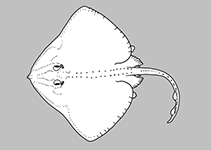
This species (probably of medium size) is distinguished by the following set of characters: a small but conspicuous preorbital thorn; velvety dorsal surface of disc which is covered with fine denticles; velvety ventral surface with widely spaced and very fine denticles; long and slender tail, entirely velvety and without enlarged thorns; lateral tail folds are not expanded distally, narrower than tail for their whole length; nasal lobes are not greatly expanded, width of nasal curtain 7.3-8.3% TL; relatively small mouth, width more than 66% of maximum width of nasal curtain and 5.7-6.2% TL; anterior pelvic-fin lobe is shorter than posterior lobe; dorsal surfaces plain pale yellowish brown, ventral surface creamy white; total pectoral-fin radials 64-66, monospondylous centra 25, total diplospondylous centra 119-127, total number of centra 144-152 (Ref. 91035).
Body shape (shape guide): other (see remarks); Cross section: flattened.
Found on nearby insular slope. Life history unknown (Ref. 114953).
Cycle de vie et comportement reproducteur
Maturité | Reproduction | Frai | Œufs | Fécondité | Larves
Séret, B. and P.R. Last, 2012. New deep water skates of the genus Notoraja Ishiyama, 1958 (Rajoidei, Arhynchobatidae) from the southwest Pacific. Zoosystema, 34 (2):319-341. (Ref. 91035)
Statut dans la liste rouge de l'IUCN (Ref. 130435: Version 2025-2 (Global))
Menace pour l'homme
Harmless
Utilisations par l'homme
Outils
Articles particuliers
Télécharger en XML
Sources Internet
Estimations basées sur des modèles
Température préférée (Réf.
123201): 8.5 - 9.8, mean 8.6 °C (based on 6 cells).
Indice de diversité phylogénétique (Réf.
82804): PD
50 = 0.5000 [Uniqueness, from 0.5 = low to 2.0 = high].
Bayesian length-weight: a=0.00550 (0.00279 - 0.01081), b=3.11 (2.94 - 3.28), in cm total length, based on LWR estimates for this (Sub)family-body shape (Ref.
93245).
Niveau trophique (Réf.
69278): 3.7 ±0.7 se; based on size and trophs of closest relatives
Résilience (Réf.
120179): Faible, temps minimum de doublement de population : 4,5 à 14 années (Preliminary low fecundity).
Vulnérabilité de la pêche (Ref.
59153): Low to moderate vulnerability (30 of 100).
🛈