Classificazione / Nomi
Nomi Comuni | Sinonimi | Catalog of Fishes(Genere, Specie) | ITIS | CoL | WoRMS | Cloffa
>
Atheriniformes (Silversides) >
Melanotaeniidae (Rainbowfishes, blue eyes)
Etymology: Melanotaenia: Greek, melan, -anos = black + latin, taenia = stripe (Ref. 45335); wanoma: Named in reference to Wanoma village located some 16 km to the north in Arguni Bay.
Ambiente: milieu / zona climatica / distribuzione batimetrica / gamma di distribuzione
Ecologia
; acqua dolce benthopelagico. Tropical
Asia: Indonesia.
Dimensione / Peso / Età
Maturità: Lm ? range ? - ? cm
Max length : 7.3 cm SL maschio/sesso non determinato; (Ref. 91054)
Breve descrizione
Chiavi di identificazione | Morfologia | Morfometria
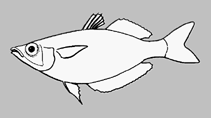
Spine dorsali (totale) : 4 - 6; Raggi dorsali molli (totale) : 14 - 15; Spine anali: 1; Raggi anali molli: 22 - 25. Can be diagnosed from all of congeners in the Bomberai Peninsula and Bird’s Neck region by the combination of the following characters: dorsal fin with IV to VI-I,14 to 15 rays; anal fin with I,22-25 rays; 34-36 lateral scales; 10-11 transverse scales; 15-17 predorsal scales; 14-18 cheek scales; 15-16 gillrakers; snout length 8.0-9.1% of SL; interorbital width 8.4-9.0% of SL; body depth 28.7-32.8 and width 11.4- 13.5% SL; caudal peduncle length 14.0-16.1 and depth 10.0-11.1% SL; predorsal length 47.3-49.5% of SL; prepelvic length 38.3-40.4% of SL; preanal length 49.6-52.8% of SL; spine length of the first dorsal fin 10.2-12.1% of SL; spine length of the anal fin 9.1-10.4% of SL; dorsal-fin base length 36.8-40.5% of SL; second dorsal-fin base length, 24.3-27.5% of SL; a prominent white margin stripe with a reddish extremity respectively on the second dorsal fin and on the anal fin (Ref. 91054).
Body shape (shape guide): fusiform / normal.
The type locality, Wermura Creek, emerges from a small cave then flows on about 200 m before disappearing in a subterranean outlet and reappears after 1 km in the mangrove from a large cave and flows to the Arguni Bay. It consists of a crystalline stream, narrow (to about 1 m wide), relatively shallow (up to about 1 m) and flowing in primary forest (Ref. 91054).
Ciclo vitale e comportamento di accoppiamento
Maturità | Riproduzione | Deposizione | Uova | Fecondità | Larve
Kadarusman, R.K. Hadiaty, G. Segura, G. Setiawibawa, D. Caruso and L. Pouyaud, 2012. Four new species of Rainbowfishes (Melanotaeniidae) from Arguni Bay, West Papua, Indonesia. Cybium 36(2):369-382. (Ref. 91054)
Stato della Lista Rossa IUCN (Ref. 130435: Version 2025-2 (Global))
Minaccia per l'uomo
Harmless
Usi umani
Pesca: di potenziale interesse; Acquario: Potenziale
Strumenti
Rapporti speciali
Scarica XML
Fonti Internet
Stime basate su modelli
Indice di diversità filogenetica (Fonte Biblio.
82804): PD
50 = 0.5000 [Uniqueness, from 0.5 = low to 2.0 = high].
Bayesian length-weight: a=0.01122 (0.00514 - 0.02450), b=3.04 (2.87 - 3.21), in cm total length, based on all LWR estimates for this body shape (Ref.
93245).
Livello trofico (Fonte Biblio.
69278): 2.9 ±0.4 se; based on size and trophs of closest relatives
Resilienza (Fonte Biblio.
120179): Medio, tempo minimo di raddoppiamento della popolazione 1.4 - 4.4 anni (Preliminary K or Fecundity.).
Vulnerabilità della pesca (Ref.
59153): Low vulnerability (10 of 100).
🛈