Classificazione / Nomi
Nomi Comuni | Sinonimi | Catalog of Fishes(Genere, Specie) | ITIS | CoL | WoRMS | Cloffa
>
Atheriniformes (Silversides) >
Melanotaeniidae (Rainbowfishes, blue eyes)
Etymology: Melanotaenia: Greek, melan, -anos = black + latin, taenia = stripe (Ref. 45335); urisa: Named with reference to the village name (Urisa) near the type locality.
Ambiente: milieu / zona climatica / distribuzione batimetrica / gamma di distribuzione
Ecologia
; acqua dolce benthopelagico. Tropical
Asia: Indonesia.
Dimensione / Peso / Età
Maturità: Lm ? range ? - ? cm
Max length : 8.8 cm SL maschio/sesso non determinato; (Ref. 91054)
Breve descrizione
Chiavi di identificazione | Morfologia | Morfometria
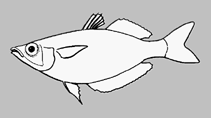
Spine dorsali (totale) : 4 - 5; Raggi dorsali molli (totale) : 12 - 15; Spine anali: 1; Raggi anali molli: 21 - 23. Can be diagnosed from all its congeners from Bomberai Peninsula and Bird’s Neck region by the combination of the following characters: dorsal fin with IV to V-I,12 -15 rays; anal fin with I,21-23 rays ; 36-39 lateral scales; 10-11 transverse scales; 18-20 predorsal scales; 13-16 cheek scales; 17-18 gillrakers; head length 23.7-25.2% of standard length; snout length 7.6-8.7% of SL; interorbital width 7.9-8.8% of SL; eye diameter, 8.0-9.0% of SL; body width 10.0-11.2% of SL; predorsal length 50.6-54.5% of SL; prepelvic length 36.3-39.2% of SL; preanal length 47.0-49.1% of SL; caudal peduncle length 16.3-19.0 and depth 8.6-10.0% of SL; pectoral fin length 15.2-17.4% of SL and pelvic fin 11.0-13.7% of SL; anal fin height 6.8-9.9% of SL; spine length on the anal fin 7.1-8.5% of SL; dorsal-fin base length 30.8-35.7% of SL and second dorsal-fin base length 20.4-23.5% of SL (Ref. 91054).
Body shape (shape guide): fusiform / normal.
Occurs in a karst spring, consisting of an artesian resurgence of blue freshwater in a brackish swampy environment with a size and volume varying with the season and with the tidal fluctuation. The bottom of the spring is composed of white sand and limestone boulder with substantial dead tree branches. Syntopic with an unknown species of crayfishes, Cherax sp. (Ref. 91054).
Ciclo vitale e comportamento di accoppiamento
Maturità | Riproduzione | Deposizione | Uova | Fecondità | Larve
Kadarusman, R.K. Hadiaty, G. Segura, G. Setiawibawa, D. Caruso and L. Pouyaud, 2012. Four new species of Rainbowfishes (Melanotaeniidae) from Arguni Bay, West Papua, Indonesia. Cybium 36(2):369-382. (Ref. 91054)
Stato della Lista Rossa IUCN (Ref. 130435: Version 2025-2 (Global))
Minaccia per l'uomo
Harmless
Usi umani
Pesca: di potenziale interesse; Acquario: Potenziale
Strumenti
Rapporti speciali
Scarica XML
Fonti Internet
Stime basate su modelli
Indice di diversità filogenetica (Fonte Biblio.
82804): PD
50 = 0.5000 [Uniqueness, from 0.5 = low to 2.0 = high].
Bayesian length-weight: a=0.01122 (0.00514 - 0.02450), b=3.04 (2.87 - 3.21), in cm total length, based on all LWR estimates for this body shape (Ref.
93245).
Livello trofico (Fonte Biblio.
69278): 2.9 ±0.4 se; based on size and trophs of closest relatives
Resilienza (Fonte Biblio.
120179): Medio, tempo minimo di raddoppiamento della popolazione 1.4 - 4.4 anni (Preliminary K or Fecundity.).
Vulnerabilità della pesca (Ref.
59153): Low vulnerability (10 of 100).
🛈