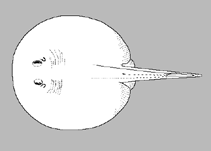
Ταξινόμηση / Ονόματα
Κοινά ονόματα | Συνώνυμα | Catalog of Fishes(Γένος, Είδη) | ITIS | CoL | WoRMS | Cloffa
Ελασμοβράγχιοι (καρχαρίες και σαλάχια) (sharks and rays) >
Myliobatiformes (Stingrays) >
Potamotrygonidae (River stingrays) > Potamotrygoninae
Etymology: Potamotrygon: Greek, potamos = river + Greek, trygon = a sting ray (Ref. 45335); amandae: Named for Amanda Lucas Gimeno, who was an undergraduate colleague of the first author.
Eponymy: Amanda Lucas Gimeno (1984–2006) was a Brazilian biologist who graduated (2005) from the University of São Paulo, where the senior author had been one of her undergraduate colleagues. [...] (Ref. 128868), visit book page.
Περιβάλλον: περιβάλλον / κλιματική ζώνη / εύρος βάθους / εύρος διανομής
Οικολογία
; Γλυκού νερού βενθοπελαγικό. Tropical
South America: Paraná-Paraguay basin.
Μέγεθος / Βάρος / Ηλικία
Γεννητική Ωρίμανση: Lm ? range ? - ? cm
Max length : 31.2 cm WD αρσενικό/απροσδιόριστο; (Ref. 95047); 34.1 cm WD (female)
Σύντομη περιγραφή
Κλείδες προσδιορισμού | Μορφολογία | Μορφομετρία
Σπόνδυλοι: 113 - 129. Distinguished from other species of the genus of Potamotrygon in the Paraná-Paraguay basin, except P. motoro and P. pantanensis, by its predominantly grayish or dark brown dorsal background color usually with bicolored ocelli on dorsal disc (vs. lacking ocelli in P. falkneri, P. histrix, P. schuhmacheri, and P. brachyura; some specimens of P. amandae without ocelli and have a uniform dark brown or gray dorsal color). Can be diagnosed from P. motoro and P. pantanensis by having the following combination of characters: dorsal background predominantly grayish or dark brown (P. motoro with dorsal disc background color gray, dark gray, olive, olivaceous brown, or dark brown, and P. pantanensis with dorsal disc background brown); ocelli, when present, with two colors, with a whitish, light gray or light yellow central area surrounded by a black peripheral ring (tricolored ocelli with a peripheral dark ring, yellowish or orange center and with an intermediate band in P. motoro; bicolored ocelli with a beige, orange or dark yellow central area surrounded by a peripheral black ring in P. pantanensis); ventral disc grayish, covering almost all of ventral disc (ventral color predominantly whitish over central disc in P. motoro and P. pantanensis); dermal denticles differ from P. motoro due to their smaller size and without developed coronal plates in P. amandae and from P. pantanensis due to their distribution over almost entire dorsal side of disc (in P. motoroand P. pantanensis, dermal denticles do not cover almost entire dorsal disc); greater spiracular length compared to P. motoro and P. pantanensis, with mean 10.1% DW (ranging from 8.2 to 12.8% DW), whereas in P. motoro spiracular mean length is 8.0% DW (ranging from 6.7 to 9.8% DW), and in P. pantanensis mean spiraclular length is 8.7% DW (ranging from 7.6 to 9.6% DW); relatively longer tail, with tail length averaging 82.1% DW, whereas mean tail length is 78.5% DW in P. motoro and 73.4% DW in P. pantanensis; tail relatively more slender in P. amandae, with mean tail width 11.0% DW (ranging from 7.2 to 13.6% DW), whereas in P. motoro and P. pantanensis mean tail width is, respectively, 13.4% DW and 13.2% DW (ranging from 10.5 to 14.8% and 11.2 to 15.5% DW, respectively); frontoparietal fontanelle of neurocranium constricted at midlength (unconstricted in P. motoro and P. pantanensis), and postorbital process clearly more developed than in P. motoro and P. pantanensis; anterior angular cartilage with its medial portion at articulation with Meckel’s cartilages highly curved (J-shaped), and much greater than posterior angular cartilage (both angular cartilages subequal in P. motoro, and P. pantanensis with anterior angular cartilage rather straight, not J-shaped) (Ref. 95047).
Κύκλος ζωής και συμπεριφορά ζευγαρώματος
Γεννητική Ωρίμανση | Αναπαραγωγή | Γεννοβολία | Αβγά | Γονιμότητα | Προνύμφες
Loboda, T.S. and M.R. de Carvalho, 2013. Systematic revision of the Potamotrygon motoro (Müller & Henle, 1841) species coplex in the Paraná-Paraguay basin, with description of two new ocellated species (Chondrichthyes: Myliobatiformes: Potamotrygonidae). Neotrop. Ichthyol/ 11(4):693-737. (Ref. 95047)
Κατάσταση Κόκκινου Καταλόγου IUCN (Ref. 130435: Version 2025-2 (Global))
Απειλή για τον άνθρωπο
Harmless
Ανθρώπινες χρήσεις
Εργαλεία
Ειδικές εκθέσεις
Λήψη XML
Διαδικτυακές πηγές
Εκτιμήσεις βάσει μοντέλων
Δείκτης φυλογενετικής ποικιλότητας (Αναφ.
82804): PD
50 = 0.5000 [Uniqueness, from 0.5 = low to 2.0 = high].
Bayesian length-weight: a=0.01000 (0.00244 - 0.04107), b=3.04 (2.81 - 3.27), in cm total length, based on all LWR estimates for this body shape (Ref.
93245).
Τροφικό Επίπεδο (Αναφ.
69278): 3.2 ±0.4 se; based on size and trophs of closest relatives
Ευπάθεια στην αλιεία (Ref.
59153): High vulnerability (58 of 100).
🛈