Classification / Noms
Noms communs | Synonymes | Catalog of Fishes(Genre, Espèce) | ITIS | CoL | WoRMS | Cloffa
>
Cichliformes (Cichlids, convict blennies) >
Cichlidae (Cichlids) > Geophaginae
Etymology: Geophagus: Greek, gea = the earth + Greek, phagein = to eat (Ref. 45335); crocatus: From the Latin adjective crocatus, meaning saffron yellow, in reference to the yellow operculum on
live specimens.
Environnement : milieu / zone climatique / profondeur / gamme de distribution
Écologie
; eau douce benthopélagique; pH range: 4.1 - 7.1. Tropical; 25°C - 33°C (Ref. 95093)
South America: Berbice River, above and below the rapids at Itabru Falls in Guyana.
Taille / Poids / Âge
Maturité: Lm ? range ? - ? cm
Max length : 16.6 cm SL mâle / non sexé; (Ref. 95093)
Description synthétique
Clés d'identification | Morphologie | Morphométrie
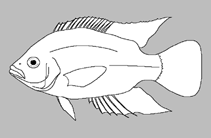
Épines dorsales (Total) : 17; Rayons mous dorsaux (Total) : 11 - 12; Épines anales: 3; Rayons mous anaux: 7 - 8; Vertèbres: 32 - 33. Differs from Geophagus grammepareius, G. taeniopareius, G. argyrostictus, G. gottwaldi and G. harreri by its incomplete suborbital stripe (vs. complete). Can be further diagnosed from G. abalios, G. brokopondo, G. surinamensis, G megasema, G camopiensis, G. altifrons, G. parnaibae, G. sveni, and G. neambi by having an incomplete suborbital stripe formed by a preopercular black mark (vs. absent). The lateral bar pattern of Geophagus crocatus distinguishes this species from all other congeners. The bar pattern is formed by 6 vertical bars on the flank, with bars 2 and 3 uniquely fused dorsally at the base of the spiny dorsal fin between spines 9 and 10. Distinguished from all members of the G. surinamensis complex with incomplete suborbital markings by the presence of 6 lateral bars (vs. absent in G. proximus and G. brachybranchus, 4 bars in G. winemilleri, and 7 bars in G. dicrozoster (Ref. 95093).
Body shape (shape guide): fusiform / normal.
Inhabits black water river, running through thick gallery forest. Mostly found abundat in areas of sluggish water with sandy bottoms and relatively little forest cover (Ref. 95093).
Cycle de vie et comportement reproducteur
Maturité | Reproduction | Frai | Œufs | Fécondité | Larves
Hauser, F.E. and H. López-Fernández, 2013. Geophagus crocatus, a new species of geophagine cichlid from the Berbice River, Guyana, South America (Teleostei: Cichlidae). Zootaxa 3731(2):279-286. (Ref. 95093)
Statut dans la liste rouge de l'IUCN (Ref. 130435: Version 2025-2 (Global))
Menace pour l'homme
Harmless
Utilisations par l'homme
Outils
Articles particuliers
Télécharger en XML
Sources Internet
Estimations basées sur des modèles
Indice de diversité phylogénétique (Réf.
82804): PD
50 = 0.5000 [Uniqueness, from 0.5 = low to 2.0 = high].
Bayesian length-weight: a=0.02042 (0.00914 - 0.04559), b=3.02 (2.85 - 3.19), in cm total length, based on LWR estimates for this Genus-body shape (Ref.
93245).
Niveau trophique (Réf.
69278): 2.3 ±0.1 se; based on size and trophs of closest relatives
Résilience (Réf.
120179): Haut, temps minimum de doublement de population inférieur à 15 mois (Preliminary K or Fecundity.).
Vulnérabilité de la pêche (Ref.
59153): Low vulnerability (10 of 100).
🛈