klasifikasi / Nama
Nama-nama umum | Sinonim (persamaan) | Catalog of Fishes(Marga, Jenis) | ITIS | CoL | WoRMS | Cloffa
>
Atheriniformes (Silversides) >
Phallostethidae (Priapiumfishes)
Etymology: Neostethus: Greek,neos = new + Greek, stetho, stethion = brest; literal = to prick a little breast (Ref. 45335); geminus: From the Latin geminus for twin or double referring to the close morphological similarity of the new species to its inferred sister species, Neostethus bicornis, and to the paired or double ctenactinia in both species.
Lingkungan: lingkungan / zona iklim / kisaran kedalaman / jangkauan distribusi
Ekologi
; air tawar; payau bentopelagis. Tropical; 27°C - ? (Ref. 95599)
Asia: Brunei Darussalam.
Ukuran / Berat / umur
Kematangan: Lm ? range ? - ? cm
Max length : 2.6 cm SL jantan/; (Ref. 95599)
deskripsi pendek
Kunci identifiaksi (pengenalan) | Morfologi | Morfometrik
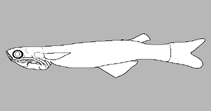
Sirip dubur lunak: 15 - 16; vertebrata, bertulang belakang: 35 - 37. Neostethus geminus is most closely related to N. bicorni. Both species differ from all congeners by having two elongate curved ctenactinia (vs. one elongate and one short ctenactinium) in mature males and a brown blotch on the pelvic-fin rays of the proctal side of immature males, and a fleshy, hood-like fold in females that includes the anus and genital and urinary pores. Neostethus geminus is distinguished from N. bicornis in being smaller (reaching no more than 2.57 cm SL vs. 3.1cm SL), and having a relatively compact priapium with a foreshortened, broad aproctal axial bone that meets but does not overlap the pulvinular appendage (vs. a relatively elongate priapium with a long and narrow aproctal axial bone that overlaps the pulvinular appendage medially); thin, nearly translucent, broad papillary bone expanded distally into a tab (vs. a short papillary bone), and females with a thickened fleshy, hood-like fold that includes the anus, genital pore and urinary pore (vs. a thin fold of skin), and a thickened ridge just posterior to the fold and separated from it by a gap (vs. lacking a ridge and a gap) (Ref. 95599).
Body shape (shape guide): elongated.
At the type locality, this species was collected together with other fishes: Ambassis sp., Scatophagus argus, Tetraodon leiurus, Gobiopterus brachypterus, and Brachygobius doriae and Neostethus borneensis. The brackish water was clear and brown (Ref. 95599).
Siklus hidup dan perilaku kawin
Kematangan | Reproduksi, perkembang biakan | Pemijahan | telur-telur | Fekunditas | Larva
Parenti, L.R., 2014. A new species of Neostethus (Teleostei; Atherinomorpha; Phallostethidae) from Brunei Darussalam, with comments on northwestern Borneo as an area of endemism. Raffles Bull. Zool. 62:175-187. (Ref. 95599)
Status IUCN Red List (Ref. 130435: Version 2025-2 (Global))
ancaman kepada manusia
Harmless
penggunaan manusia
Perikanan: tidak ada kepentingan
Alat, peralatan
laporan khas
muat turun XML
Sumber internet
Estimasi berdasarkan model
Indeks keanekaragaman filogenetik (Acuan
82804): PD
50 = 0.5002 [Uniqueness, from 0.5 = low to 2.0 = high].
Bayesian length-weight: a=0.00389 (0.00180 - 0.00842), b=3.12 (2.94 - 3.30), in cm total length, based on all LWR estimates for this body shape (Ref.
93245).
Tingkat Trofik (Acuan
69278): 3.0 ±0.3 se; based on size and trophs of closest relatives
Kerentanan Penangkapan Ikan (Ref.
59153): Low vulnerability (10 of 100).
🛈