>
Perciformes/Serranoidei (Groupers) >
Liopropomatidae (Painted basslets) > Liopropomatinae
Etymology: Liopropoma: Greek, leio = smooth + Greek, pro = in front of + Greek, poma, -atos = cover, operculum (Ref. 45335); olneyi: Named for John E. Olney.
Eponymy: John Edward Olney Sr (1947–2010) was an American ichthyologist, fisheries biologist and naturalist who worked at the Virginia Institute of Marine Science. [...] (Ref. 128868), visit book page.
Ambiente: milieu / zona climatica / distribuzione batimetrica / gamma di distribuzione
Ecologia
marino pelagic-neritic; distribuzione batimetrica 123 - 220 m (Ref. 95863). Tropical
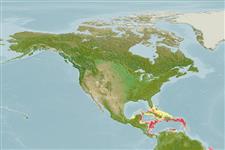
Caribbean: adults are known from images and specimens from Curaçao. Larvae are known from the Florida Straits and Gulf of Mexico.
Dimensione / Peso / Età
Maturità: Lm ? range ? - ? cm
Max length : 8.4 cm SL maschio/sesso non determinato; (Ref. 95863)
Breve descrizione
Chiavi di identificazione | Morfologia | Morfometria
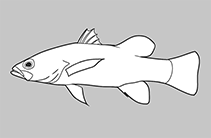
Spine dorsali (totale) : 9; Raggi dorsali molli (totale) : 11; Spine anali: 3; Raggi anali molli: 8; Vertebre: 24. This liopropomin serranid is distinguished by the following set of adult and larval characters: D IX,11; A III, 8; pectoral fin 14-15; in adults - lateral-line scales 46-48, length of first dorsal spine 4.5% SL; margin of spinous dorsal fin shallowly indented posteriorly (fourth spine 9.7-12% SL, fifth spine only slightly shorter than fourth, 8.3-9.3% SL, and sixth-ninth spines approximately subequal, 5.5–8.9% SL); in larvae, second-eighth spines elongate, 57.1-150% SL; body of adults slender, depth at dorsal-fin origin 23% SL and the least caudal-peduncle depth is 13-15% SL. Predominant color of adults when alive is yellow; yellow covering dorsal portion of trunk, in stripe from tip of upper jaw to posterior edge of operculum and in narrower broken stripe from ventral edge of orbit to posterior edge of operculum, on dorsal and caudal fins, and in stripe on anal fin; top of head is dark rose/orange, ventral portions of head and trunk pale rose to white; dorsal and ventral portions of trunk with scattered yellow spots. When preserved in alcohol, the head and trunk uniformly pale, slightly paler on abdomen and throat. Larvae has a conspicuous pattern of orange chromatophores in life on head and trunk, orange pigment on elongate second dorsal-fin spine associated with swellings in sheath covering spine, several orange blotches on anal-fin rays, large blotch of orange pigment covering most of pelvic fin, and melanophores on spinous dorsal fin (Ref. 95863).
Body shape (shape guide): fusiform / normal; Cross section: compressed.
Collected from rocky slopes and ledges. When threatened, it retreats into small caves and crevices. Larva from Florida Straits was captured between 25 and 50 m (Ref. 95863).
Ciclo vitale e comportamento di accoppiamento
Maturità | Riproduzione | Deposizione | Uova | Fecondità | Larve
Baldwin, C. and G.D. Johnson, 2014. Connectivity across the Caribbean Sea: DNA barcoding and morphology unite an enigmatic fish larva from the Florida Straits with a new species of sea bass from deep reefs off Curaçao. PLoS ONE 9(5):e97661. (Ref. 95863)
Stato della Lista Rossa IUCN (Ref. 130435: Version 2025-2 (Global))
Minaccia per l'uomo
Harmless
Usi umani
Strumenti
Rapporti speciali
Scarica XML
Fonti Internet
Stime basate su modelli
Temperatura preferita (Fonte Biblio.
123201): 19.7 - 23.7, mean 21.4 °C (based on 7 cells).
Indice di diversità filogenetica (Fonte Biblio.
82804): PD
50 = 0.5000 [Uniqueness, from 0.5 = low to 2.0 = high].
Bayesian length-weight: a=0.01122 (0.00514 - 0.02450), b=3.04 (2.87 - 3.21), in cm total length, based on all LWR estimates for this body shape (Ref.
93245).
Livello trofico (Fonte Biblio.
69278): 3.7 ±0.6 se; based on size and trophs of closest relatives
Vulnerabilità della pesca (Ref.
59153): Low vulnerability (10 of 100).
🛈