>
Perciformes/Serranoidei (Groupers) >
Liopropomatidae (Painted basslets) > Liopropomatinae
Etymology: Liopropoma: Greek, leio = smooth + Greek, pro = in front of + Greek, poma, -atos = cover, operculum (Ref. 45335); santi: Named for Roger Sant, one of the collectors and a donor of Smithsonian Institution’s National Museum of Natural History for ocean-related activities.
Eponymy: Roger West Sant (d: 1931) is an American businessman and philanthropist who is Co-Founder & Chairman Emeritus of the AES Corporation and Chairman of the Summit Foundation, which he and his late wife (d: 2018) Victoria founded (1991) when AES went [...] (Ref. 128868), visit book page.
Environnement : milieu / zone climatique / profondeur / gamme de distribution
Écologie
marin pelagic-neritic; profondeur 182 - 241 m (Ref. 95858). Tropical
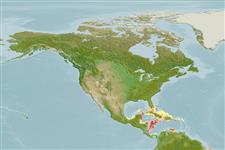
Caribbean: Curaçao.
Taille / Poids / Âge
Maturité: Lm ? range ? - ? cm
Max length : 11.6 cm SL mâle / non sexé; (Ref. 95858)
Description synthétique
Clés d'identification | Morphologie | Morphométrie
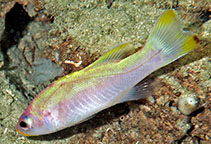
Épines dorsales (Total) : 8; Rayons mous dorsaux (Total) : 13; Épines anales: 3; Rayons mous anaux: 8; Vertèbres: 24. This species is distinguished by the following set of characters: D VIII,13; A III, 8; pectoral fin 15; 20-21 total gill rakers on first arch (including rudiments); 47-48 lateral-line scales; length of first dorsal spine, 2.9-4.2% SL; margin of spinous dorsal fin moderately indented posteriorly in adults (fourth spine 11-12% SL, fifth and sixth spines only slightly shorter than fourth, 6.9-10% SL); depth at origin of dorsal fin, 23-26% SL; least depth of caudal peduncle, 11-13% SL; orbit diameter, 9.4-12% SL; upper lip with yellow-orange stripe; approximately 13 white, chevron-shaped markings in a series on the ventral portion of trunk; a reddish-black blotch on distal portion of lower caudal-fin lobe (Ref. 95858).
Body shape (shape guide): fusiform / normal; Cross section: compressed.
Inhabits rocky slopes and ledges. When approached and illuminated by the submersible, it retreated into small caves and crevices (Ref. 95858).
Cycle de vie et comportement reproducteur
Maturité | Reproduction | Frai | Œufs | Fécondité | Larves
Baldwin, C. and D.R. Robertson, 2014. A new Liopropoma sea bass (Serranidae, Epinephelinae, Lipropomini) from deep reefs off Curaçao, southern Caribbean, with comments on depth distributions of western Atlantic liopropomins. ZooKeys 409:71-92. (Ref. 95858)
Statut dans la liste rouge de l'IUCN (Ref. 130435: Version 2025-2 (Global))
Menace pour l'homme
Harmless
Utilisations par l'homme
Outils
Articles particuliers
Télécharger en XML
Sources Internet
Estimations basées sur des modèles
Température préférée (Réf.
123201): 19.9 - 22.7, mean 22.7 °C (based on 3 cells).
Indice de diversité phylogénétique (Réf.
82804): PD
50 = 0.5000 [Uniqueness, from 0.5 = low to 2.0 = high].
Bayesian length-weight: a=0.01122 (0.00514 - 0.02450), b=3.04 (2.87 - 3.21), in cm total length, based on all LWR estimates for this body shape (Ref.
93245).
Niveau trophique (Réf.
69278): 3.8 ±0.6 se; based on size and trophs of closest relatives
Vulnérabilité de la pêche (Ref.
59153): Low vulnerability (10 of 100).
🛈