>
Gobiiformes (Gobies) >
Gobiidae (Gobies) > Gobiinae
Etymology: Eviota: No etymology given, suggested by Christopher Scharpt: from Latin 'eu' for 'true' and 'iota' for anything very small, in combination 'truly very small' referring to it as being the smallest vertebrate at the time it has benn described by Jenkins (thus, making the suggestion by Scharpt plausible; brahmi: Named for Brahm Kai Erdmann, who recognized that the species had been incorrectly identified as E. nigriventris in literature; a noun in the Latin genitive case.
Eponymy: Brahm Kai Erdmann is the son of Canadian marine biologist Mark V Erdmann, Curator Emeritus ROM. [...] (Ref. 128868), visit book page.
Ambiente: milieu / zona climática / intervalo de profundidade / gama de distribuição
Ecologia
marinhas associadas(os) a recifes; intervalo de profundidade 0 - 20 m (Ref. 95677). Tropical
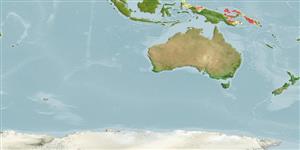
Western Pacific: Papua New Guinea.
Tamanho / Peso / Idade
Maturidade: Lm ? range ? - ? cm
Max length : 1.7 cm SL macho/indeterminado; (Ref. 95677); 1.5 cm SL (female)
Descrição breve
Chaves de identificação | Morfologia | Morfometria
Espinhos dorsais (total) : 7; Raios dorsais moles (total) : 9 - 11; Espinhos anais: 1; Raios anais moles: 8 - 10. This species is distinguished from its congeners by the following characters: entire lower body with a red stripe, from the eye back to caudal-fin base where it grades into black ending in a dorsally asymmetrical spot that angles sharply towards the ventral portion of the caudal fin; pectoral-fin base with line of small black dots extending down to its base, the upper half are larger and more intense, the ones on the lower half smaller, less intense, and expanded across lower part of the base; cephalic sensory pore system lacking the PITO and IT pores and the AITO pore is enlarged; usually 10/9 dorsal/anal fin-ray formula; simple pectoral-fin rays; in both sexes the spinous dorsal-fin elongate or filamentous; genital papilla nonfimbriate. In life, the ventral red stripe is bordered dorsally by a bright white stripe that runs from the top of the head back to the caudal fin where it curves down following the angled black spot; the eye without a narrow white line on the iris above the pupil; a wide white line extends up the interorbital area, the width of the line extending from eye to eye (Ref. 95677).
Cross section: oval.
Ciclo de vida e comportamento de acasalamento
Maturidade | Reprodução | Desova | Ovos | Fecundidade | Larvas
Greenfield, D.W. and L. Tornabene, 2014. Eviota brahmi n. sp. From Papua New Guinea, with redescription of Eviota nigriventris (Teleostei: Gobiidae). Zootaxa 3793(1):133-146. (Ref. 95677)
Categoria na Lista Vermelha da IUCN (Ref. 130435: Version 2025-2 (Global))
Ameaça para o homem
Harmless
Utilização humana
Ferramentas
Relatórios especiais
Descarregue XML
Fontes da internet
Estimativas baseadas em modelos
Temperatura preferida (Ref.
123201): 28.7 - 29.4, mean 29 °C (based on 194 cells).
Índice de diversidade filogenética (Ref.
82804): PD
50 = 0.5000 [Uniqueness, from 0.5 = low to 2.0 = high].
Bayesian length-weight: a=0.00692 (0.00281 - 0.01706), b=3.09 (2.92 - 3.26), in cm total length, based on LWR estimates for this Genus-body shape (Ref.
93245).
Nível Trófico (Ref.
69278): 3.0 ±0.3 se; based on size and trophs of closest relatives
Resiliência (Ref.
120179): Elevada, tempo mínimo de duplicação da população menor que 15 meses (Preliminary K or Fecundity.).
Vulnerabilidade da pesca (Ref.
59153): Low vulnerability (10 of 100).
🛈