การจำแนกประเภท / ชื่อ
ชื่อสามัญ | ชื่อพ้อง | Catalog of Fishes(สกุล, ชนิด) | ITIS | CoL | WoRMS | Cloffa
>
Eupercaria/misc (Various families in series Eupercaria) >
Sparidae (Porgies)
Etymology: Acanthopagrus: Greek, akantha = thorn + Greek, pagros, a kind of fish (Ref. 45335); morrisonae: Named for S. Morrison, Western Australian Museum.
Eponymy: Susan ‘Sue’ M Morrison worked at the Fish Section, Aquatic Zoology, Western Australian Museum, Perth. [...] (Ref. 128868), visit book page.
สิ่งแวดล้อม : สิ่งแวดล้อม / เขตภูมิอากาศ / ระดับความลึก / ระยะการกระจายสินค้า
นิเวศวิทยา
เกี่ยวกับทะเล,น้ำเค็ม pelagic-neritic. Subtropical
Eastern Indian Ocean: Northwestern Australia.
ขนาด / น้ำหนัก / อายุ
วัยเจริญพันธุ์: Lm ? range ? - ? cm
Max length : 45.0 cm TL เพศผู้/กระเทย; (Ref. 93743); น้ำหนักสูงสุดที่มีการรายงาน: 2.0 kg (Ref. 93743)
คำอธิบายสั้นๆ
เครื่องมือที่ใช้ในการแยกชนิดสัตว์,สิ่งมีชีวิตออกจากกัน | สัณฐานวิทยา | ความยาวต่างๆ
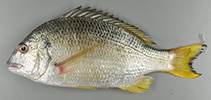
เงี่ยงครีบหลัง (รวม) : 11; ก้านครีบอ่อนที่หาง (รวม) : 10 - 12; เงี่ยงครีบก้น: 3; ก้านครีบอ่อนที่ก้น: 8. This species is distinguished from its congeners by the following set of characters: moderately deep body, 2.0-2.4 (mean 2·2) times in SL: D XI,11 (rarely XI,10); first soft dorsal-fin ray slightly longer than last dorsal-fin spine; scale rows between fifth dorsal-fin spine base and lateral line 3.5 ; scale rows above lateral line 4.5, scale rows below 11.5; short second anal-fin spine, ordinary [16.7-.20.7% (mean 18.4%) of SL], 1.1-1.3 (mean 1.2) in 2AS/3AS; pored lateral-line scales 42-45 (mode 44); pelvic, anal and caudal fins entirely vivid yellow, caudal fin with a wide black posterior margin; absence of black streaks proximally near anal-fin base on inter-radial membranes between yellow anal-fin rays; black blotches on inter-radial membranes between dorsal-fin rays absent; weak diffuse dark blotch at origin of lateral line (usually covering first pored lateral line scale) continuing as relatively black pigment over upper rear part of opercle (Ref. 93743).
Body shape (shape guide): short and / or deep; Cross section: compressed.
Occurs in shallow coastal waters and enters river mouths and estuaries. Schooling species; often feeds on tidal flats. A popular angling species, often caught with hook and line and sometimes taken by trawlers (Ref. 44894).
วงจรชีวิตและพฤติกรรมการผสมพันธุ์
วัยเจริญพันธุ์ | การสืบพันธุ์ | การวางไข่ | เซลสืบพันธ์ของเพศเมีย(ไข่) | ความดกของไข่ | ตัวอ่อน
Once males changed to functional females, they remain so throughout their life (Ref. 115743).
Iwatsuki, Y., 2013. Review of the Acanthopagrus latus complex (Perciformes: Sparidae) with descriptions of three new species from the Indo-West Pacific Ocean. J. Fish Biol. 83(1):64-95. (Ref. 93743)
สถานะบัญชีแดงของ IUCN (Ref. 130435: Version 2025-2 (Global))
ภัยคุกคามต่อมนุษย์
Harmless
การใช้ของมนุษย์
การประมง: การค้า
เครื่องมือ
รายงานพิเศษ
ดาวน์โหลด XML
แหล่งที่มาจากอินเตอร์เน็ต
การประมาณค่าตามแบบจำลอง
ดัชนีความหลากหลายทางวิวัฒนาการ (อ้างอิง
82804): PD
50 = 0.5000 [Uniqueness, from 0.5 = low to 2.0 = high].
Bayesian length-weight: a=0.01995 (0.00886 - 0.04496), b=2.97 (2.80 - 3.14), in cm total length, based on LWR estimates for this Genus-body shape (Ref.
93245).
ระดับชั้นอาหาร (อ้างอิง
69278): 3.4 ±0.4 se; based on size and trophs of closest relatives
ความสามารถในการกลับคืนสู่ปกติ (อ้างอิง
120179): ขนาดกลาง, เวลาต่ำสุดที่จะทำให้ประชากรเพิ่มขึ้นเป็น 2 เท่าใช้เวลา 1.4 - 4.4 ปี (Preliminary K or Fecundity.).
ความเสี่ยงต่อการตกปลา (Ref.
59153): Low to moderate vulnerability (35 of 100).
🛈