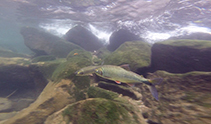
Classification / Noms
Noms communs | Synonymes | Catalog of Fishes(Genre, Espèce) | ITIS | CoL | WoRMS | Cloffa
>
Characiformes (Characins) >
Bryconidae ("Brycon characins") > Bryconinae
Etymology: Brycon: Greek, ebrykon, brykomai = to bite, to gnaw (Ref. 45335); costaricensis: The specific name refers to the country of the type locality: Costa Rica, Atlantic slope, Heredia, Sarapiquí drainage, La Virgen de Sarapiquí, Río Sarapiquí.
Environnement : milieu / zone climatique / profondeur / gamme de distribution
Écologie
; eau douce benthopélagique. Tropical; 21°C - 34°C (Ref. 95069)
Central America: Wawa basin in northern Nicaragua to Matina basin in southern Costa Rica, Atlantic slope.
Taille / Poids / Âge
Maturité: Lm ? range ? - ? cm
Max length : 32.5 cm SL mâle / non sexé; (Ref. 95069)
Description synthétique
Clés d'identification | Morphologie | Morphométrie
Rayons mous dorsaux (Total) : 11; Rayons mous anaux: 33 - 37; Vertèbres: 45. This is distinguished from all congeners in Central America by having 49 to 54 scales in the lateral line (vs. 43 to 48 in Brycon argenteus, 55 to 61 in B. guatemalensis, and more than 64 in B. behreae, B. chagrensis and B. striatulus) and anal fin notably longer than head, with 33 to 37 total rays (vs. an anal fin about equal to length of head, with 24 to 28 total rays in B. argenteus , B. obscurus, and B. petrosus, the last two species with 48 to 55 and 53 to 58 scales in the lateral line, respectively). This species can be further diagnosed from B. guatemalensis by the following combination of characters: 5 or 6 rows of scales between lateral line and pectoral fin base (vs. 7 or 8); 9 to 11 (generally 10) rows of scales between lateral line and dorsal fin base (vs. 10 to 12, generally 11); 5 to 7 (generally 6) rows of scales between lateral line and anal fin base (vs. 7 to 9, generally 8); and a elongated and shallow caudal peduncle, whose length is 1.78 to 2.35 times its depth (vs. a short and deep caudal peduncle, whose length is 1.25 to 1.61 times its depth) (Ref. 95069).
Body shape (shape guide): fusiform / normal.
This species is found in lakes, but also abundant in fast-flowing rivers and streams. It occurs at elevation from 0-600 m in lakes, rivers and creeks, and tolerates temperate ranging from 21-34°C (Ref. 95069).
Cycle de vie et comportement reproducteur
Maturité | Reproduction | Frai | Œufs | Fécondité | Larves
Angulo, A., J. Marlene and M. Gracian-Negrete, 2013. A new species of Brycon (Characiformes: Characidae) from Nicaragua and Costa Rica, with a key to the lower Mesoamerican species of the genus. Zootaxa 3731(2):255-266. (Ref. 95069)
Statut dans la liste rouge de l'IUCN (Ref. 130435: Version 2025-2 (Global))
Menace pour l'homme
Harmless
Utilisations par l'homme
Outils
Articles particuliers
Télécharger en XML
Sources Internet
Estimations basées sur des modèles
Indice de diversité phylogénétique (Réf.
82804): PD
50 = 0.5000 [Uniqueness, from 0.5 = low to 2.0 = high].
Bayesian length-weight: a=0.01413 (0.00638 - 0.03126), b=3.05 (2.87 - 3.23), in cm total length, based on LWR estimates for this Genus-body shape (Ref.
93245).
Niveau trophique (Réf.
69278): 2.8 ±0.3 se; based on size and trophs of closest relatives
Résilience (Réf.
120179): Haut, temps minimum de doublement de population inférieur à 15 mois (Preliminary K or Fecundity.).
Vulnérabilité de la pêche (Ref.
59153): Low to moderate vulnerability (30 of 100).
🛈