>
Cyprinodontiformes (Rivulines, killifishes and live bearers) >
Aphaniidae (Oriental killifishes)
Etymology: Esmaeilius: Named for Hamid Reza Esmaeili (Shiraz) for his extensive contribution to the understanding of diversity within this genus; darabensis: Links to Darab (the land of water) referring to Darab city, SE of Shiraz (Fars Province), as the species occurs in a spring near to this city.
Eponymy: Dr Hamid Reza Esmaeili is an Iranian biologist and ichthyologist at Shiraz University, Shiraz where he is full Professor of Ichthyology. [...] (Ref. 128868), visit book page.
Milieu: milieu / Klimaatzone / Diepte / verspreidingsgebied
Ecologie
; zoet water benthopelagisch. Subtropical
Asia: Kol River, Hormuzgan Basin in Iran.
Grootte / Gewicht / Leeftijd
Maturiteit: Lm ? range ? - ? cm
Max length : 3.9 cm SL mannelijk / geslacht onbekend; (Ref. 95579)
Korte beschrijving
Determinatiesleutels | Morfologie | Morfometrie
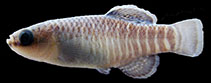
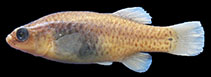
Dorsale zachte stralen (totaal) : 11 - 15; Anale zachte stralen: 10 - 13. This species can be diagnosed from its closely related species Aphanius shirini
by having 9-18 flank bars in males (vs. 7-10), small irregular vertical patches of brown color on the flank of females (vs. prominent dark brown blotches of round or irregular shape), and symmetrically shaped triangular to trapezoid otoliths with a rostrum clearly longer than the antirostrum (vs. quadrangular to trapezoid otoliths with short and equally sized rostrum and antirostrum). It differs from other congeners by the combination of four characters in both sexes: longer anal fin (15.5% SL in males, 12.1% SL in females), larger pelvic fin (8.1-12.5% SL in males, 7.04-10.3% SL in females), greater scale width (4.1-6.0% SL), and otolith characters. Furthermore, males possess greater scale length (3.0-4.8% SL) and small caudal peduncle (0.9-1.5% minimum body depth); and females have short caudal fin length (12.7-19.2% SL) (Ref. 95579).
Body shape (shape guide): fusiform / normal.
Occurs in low numbers. Threatened mainly by drought and introductions of exotic species, particularly Gambusia holbrooki and Amatitlania nigrofasciata (Ref. 95579).
Levenscyclus en paargedrag
Maturiteit | Voortplanting | Paaien | Eieren | Fecunditeit | Larven
Freyhof, J. and B. Yoğurtçuoğlu, 2020. A proposal for a new generic structure of the killifish family Aphaniidae, with the description of Aphaniops teimorii (Teleostei: Cyprinodontiformes). Zootaxa 4810(3):421-451. (Ref. 126233)
Status op de Rode Lijst van het IUCN (Ref. 130435: Version 2025-2 (Global))
Gevaar voor de mens
Harmless
Gebruik door de mens
Tools
Speciale rapporten
Download XML
Internetbronnen
Schattingen op basis van modellen
Fylogenetische diversiteitsindex (Ref.
82804): PD
50 = 0.5156 [Uniqueness, from 0.5 = low to 2.0 = high].
Bayesian length-weight: a=0.01072 (0.00652 - 0.01760), b=3.19 (3.06 - 3.32), in cm total length, based on LWR estimates for this species & Genus-body shape (Ref.
93245).
Trofisch niveau (Ref.
69278): 2.9 ±0.4 se; based on size and trophs of closest relatives
Weerstandsvermogen (Ref.
120179): Hoog, minimale populatieverdubbelingstijd minder dan 15 maanden (Preliminary K or Fecundity.).
Kwetsbaarheid van de visserij (Ref.
59153): Low vulnerability (10 of 100).
🛈