Classification / Noms
Noms communs | Synonymes | Catalog of Fishes(Genre, Espèce) | ITIS | CoL | WoRMS | Cloffa
>
Cypriniformes (Carps) >
Nemacheilidae (Brook loaches)
Etymology: bahaii: Named for Bahā’al-Dīn Muhammad ibn Husayn al-’Āmilī (also known as Shaykh-i Bahā’ī, Persian), a scholar, philosopher, architect, mathematician, astronomer and poet in 16th century Iran.
Eponymy: Bahā’ al-Dīn Muhammad ibn Husayn al-‘Āmilī (aka Shaykh-i Bahā’ī) (1547–1621) was a Persian scholar, architect, mathematician, astronomer, philosopher and poet. [...] (Ref. 128868), visit book page.
Environnement : milieu / zone climatique / profondeur / gamme de distribution
Écologie
; eau douce démersal. Subtropical
Asia: Zayandeh River in central Iran.
Longueur à la première maturité / Taille / Poids / Âge
Maturité: Lm 5.8 range ? - ? cm
Max length : 6.5 cm TL mâle / non sexé; (Ref. 127676); 8.3 cm TL (female); poids max. publié: 1.79 g (Ref. 127676); poids max. publié: 1.79 g; âge max. reporté: 5 années (Ref. 127676)
Description synthétique
Clés d'identification | Morphologie | Morphométrie
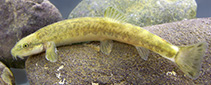
Rayons mous dorsaux (Total) : 7; Rayons mous anaux: 5. This species is distinguished uniquely from all congeners by the presence of a dark brown
blotch on each side of the anal-fin base (vs. absence) and the position of anal-fin origin at a vertical of the tip of the dorsal fin when adpressed to the body (vs. anal-fin origin clearly behind vertical of tip of dorsal fin). It further differs from all congeners in the Middle East except Turcinoemacheilus hafezi by the more posterior position of the anus (distance from anus to anal-fin origin 0.1-0.4 times in distance from pelvic-fin to anal-fin origins). It can be separated from all its four congeners in the Middle East by having five fixed nucleotide substitutions in the mtDNA COI barcode region studied (Ref. 95534).
Body shape (shape guide): elongated.
The type locality is a river with about 20 m width, substrate consisting of coarse gravel and
boulders and fast-running water (Ref. 95534).
Cycle de vie et comportement reproducteur
Maturité | Reproduction | Frai | Œufs | Fécondité | Larves
Esmaeili, H.R., G. Sayyadzadeh, M. Özulug, M. Geiger and J. Freyhof, 2014. Three new species of Turcinoemacheilus from Iran and Turkey (Teleostei: Nemacheilidae). Ichthyol. Explor. Freshwat. 24(3):257-273. (Ref. 95534)
Statut dans la liste rouge de l'IUCN (Ref. 130435: Version 2025-2 (Global))
Menace pour l'homme
Harmless
Utilisations par l'homme
Pêcheries: sans intérêt
Outils
Articles particuliers
Télécharger en XML
Sources Internet
Estimations basées sur des modèles
Indice de diversité phylogénétique (Réf.
82804): PD
50 = 0.5078 [Uniqueness, from 0.5 = low to 2.0 = high].
Bayesian length-weight: a=0.00724 (0.00352 - 0.01491), b=3.01 (2.84 - 3.18), in cm total length, based on LWR estimates for this (Sub)family-body shape (Ref.
93245).
Niveau trophique (Réf.
69278): 2.8 ±0.3 se; based on size and trophs of closest relatives
Generation time: 5.8 ( na - na) years. Estimated as median ln(3)/K based on 2
growth studies.
Résilience (Réf.
120179): Milieu, temps minimum de doublement de population : 1,4 à 4,4 années (Preliminary K or Fecundity.).
Vulnérabilité de la pêche (Ref.
59153): Low vulnerability (10 of 100).
🛈