Élasmobranches (requins et raies) (sharks and rays) >
Squaliformes (Sleeper and dogfish sharks) >
Centrophoridae (Gulper sharks)
Etymology: Deania: -ia (Gr.), belonging to: American ichthyologist Bashford Dean (1867-1928), American Museum of Natural History, for his research on selachian fishes (See ETYFish); quadrispinosa: quadri-, from quattuor (L.), four; spinosa (L.), thorny, referring to four-spined dermal denticles (See ETYFish).
Eponymy: Dr Bashford Dean (1857–1928) was an American zoologist, ichthyologist and acknowledged expert on mediaeval armour. [...] (Ref. 128868), visit book page.
Environnement : milieu / zone climatique / profondeur / gamme de distribution
Écologie
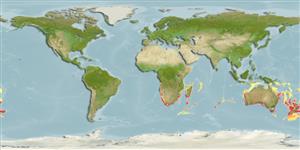
marin bathydémersal; profondeur 150 - 1360 m (Ref. 44037), usually 400 - 820 m (Ref. 6871). Deep-water; 9°S - 54°S, 12°E - 172°W (Ref. 54349)
Southeast Atlantic: off Namibia and off Algoa Bay, South Africa. Indo-West Pacific: off southern Mozambique and Natal, South Africa; Australia and New Zealand (Ref. 6871).
Longueur à la première maturité / Taille / Poids / Âge
Maturité: Lm ?, range 110 - ? cm
Max length : 115 cm TL mâle / non sexé; (Ref. 6871)
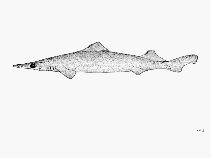
Épines dorsales (Total) : 2; Épines anales: 0. Extremely long snout, grooved dorsal fin spines, compressed cutting teeth in both jaws, moderately large, pitchfork-shaped denticles, no subcaudal keel on underside of caudal peduncle, first dorsal fin short and high (Ref. 247). Dark brown, grey, or black in color; juveniles with a dark blotch on each dorsal fin (Ref. 26346).
Body shape (shape guide): elongated.
A rare (Ref. 26346) and little-known species found on outer continental shelves and upper slopes (Ref. 247). Feeds on bony fishes (Ref. 247). Ovoviviparous (Ref. 50449).
Cycle de vie et comportement reproducteur
Maturité | Reproduction | Frai | Œufs | Fécondité | Larves
Ovoviviparous, embryos feed solely on yolk (Ref. 50449). Distinct pairing with embrace (Ref. 205).
Compagno, L.J.V., 1984. FAO Species Catalogue. Vol. 4. Sharks of the world. An annotated and illustrated catalogue of shark species known to date. Part 1 - Hexanchiformes to Lamniformes. FAO Fish. Synop. 125(4/1):1-249. Rome, FAO. (Ref. 247)
Statut dans la liste rouge de l'IUCN (Ref. 130435: Version 2025-2 (Global))
Menace pour l'homme
Harmless
Utilisations par l'homme
Pêcheries: intérêt commercial mineur
Outils
Articles particuliers
Télécharger en XML
Sources Internet
Estimations basées sur des modèles
Température préférée (Réf.
123201): 5.5 - 12.3, mean 8.2 °C (based on 236 cells).
Indice de diversité phylogénétique (Réf.
82804): PD
50 = 0.5625 [Uniqueness, from 0.5 = low to 2.0 = high].
Bayesian length-weight: a=0.00251 (0.00120 - 0.00527), b=3.19 (3.01 - 3.37), in cm total length, based on LWR estimates for this (Sub)family-body shape (Ref.
93245).
Niveau trophique (Réf.
69278): 4.5 ±0.80 se; based on food items.
Résilience (Réf.
120179): Faible, temps minimum de doublement de population : 4,5 à 14 années (Fec assumed to be <100).
Vulnérabilité de la pêche (Ref.
59153): High to very high vulnerability (69 of 100).
🛈