>
Cypriniformes (Carps) >
Leuciscidae (Minnows) > Leuciscinae
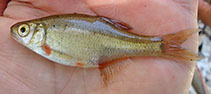
Etymology: Alburnoides: From the city of Al Bura, where the fish was known + particle Greek, oides = similar (Ref. 45335); emineae: Named for Emine Turan, the beloved mother of the first author.
Eponymy: Mrs Emine Turan is the senior author’s mother. (Ref. 128868), visit book page.
Milieu: milieu / Klimaatzone / Diepte / verspreidingsgebied
Ecologie
; zoet water benthopelagisch. Subtropical
Asia: Beyazsu Stream, drainage of Euphrates River, Persian Gulf basin in Turkey.
Grootte / Gewicht / Leeftijd
Maturiteit: Lm ? range ? - ? cm
Max length : 7.6 cm SL mannelijk / geslacht onbekend; (Ref. 94737)
Korte beschrijving
Determinatiesleutels | Morfologie | Morfometrie
Dorsale zachte stralen (totaal) : 11 - 12; Anale zachte stralen: 16 - 18; Wervels: 41 - 42. This species can be diagnosed from all congeners in Turkey and adjacent waters by the following combination of characters (none unique to the species): a well developed and generally scaleless ventral keel between pelvic and anal fins; body depth at dorsal-fin origin 31-36% SL; caudal-peduncle depth 12-13% SL and 1.5-1.7 times in SL; predorsal length 56-60% SL; dorsal-fin origin approximately vertical to mid-point pelvic-anal distance; mouth terminal, the tip of mouth cleft between level of middle of pupil and lower margin of pupil; snout with slightly pointed tip; 37-43 + 1-2 scales on lateral line, 9-10 scale rows between lateral-line and dorsal-fin origin, 4-5 scale rows between lateral-line and anal fin origin; anal fin with 13½-15½ branched rays; pharyngeal teeth 4.2-2.5, markedly hooked; total vertebrae 41-42 with mode of 41, comprising 20-21 with mode of 21 abdominal and 20-21 with mode of 20 caudal vertebrae; dark grey stripe slightly distinct in anterior part of body but clearly distinct in posterior part of body, its width greater than eye diameter; pigmentation of lateral-line distinct along lateral-line in anterior part of body but slightly distinct in posterior part of body (Ref. 94737).
Body shape (shape guide): fusiform / normal.
Found in swift and clear flowing water over cobble and pebbles. Collected together with Capoeta umbla (Heckel, 1843), Barbus lacerta Heckel, 1843, Oxynoemacheilus sp., Alburnus mossulensis Heckel, 1843, Garra rufa (Heckel, 1843) and Alburnus caeruleus Heckel, 1843 (Ref. 94737).
Levenscyclus en paargedrag
Maturiteit | Voortplanting | Paaien | Eieren | Fecunditeit | Larven
Turan, D., C. Kaya, F.G. Ekmekçi and E. Doğan, 2014. Three new species of Alburnoides (Teleostei: Cyprinidae) from Euphrates River, Eastern Anatolia, Turkey. Zootaxa 3754(2):101-116. (Ref. 94737)
Status op de Rode Lijst van het IUCN (Ref. 130435: Version 2025-2 (Global))
Gevaar voor de mens
Harmless
Gebruik door de mens
Visserij: van geen belang
Tools
Speciale rapporten
Download XML
Internetbronnen
Schattingen op basis van modellen
Fylogenetische diversiteitsindex (Ref.
82804): PD
50 = 0.5000 [Uniqueness, from 0.5 = low to 2.0 = high].
Bayesian length-weight: a=0.00741 (0.00335 - 0.01640), b=3.14 (2.97 - 3.31), in cm total length, based on LWR estimates for this Genus-body shape (Ref.
93245).
Trofisch niveau (Ref.
69278): 3.1 ±0.4 se; based on size and trophs of closest relatives
Weerstandsvermogen (Ref.
120179): Hoog, minimale populatieverdubbelingstijd minder dan 15 maanden (Preliminary K or Fecundity.).
Kwetsbaarheid van de visserij (Ref.
59153): Low vulnerability (10 of 100).
🛈