Ikan bertulang rawan (sharks and rays) >
Myliobatiformes (Stingrays) >
Aetobatidae (Pacific eagle rays)
Etymology: Aetobatus: Greek, aetos = eagle + Greek, batis, batidos = a ray (Raja sp.) (Ref. 45335); narutobiei: Named for its common name in the Japanese waters ‘Naru tobi-ei’ (pronounced ‘Nar-oo-tobee-ay’), Naru’ referring to Naru Island and ‘Tobi-ei’ the Japanese name used for eagle rays which translates to black kite (a bird); noun in apposition.
Eponymy: Though it looks as if it could be an eponym, the binomial combines ‘Naru’ (Naru Island, Japan) with ‘tobi-ei’ – the Japanese name for eagle rays. (Ref. 128868), visit book page.
Lingkungan: lingkungan / zona iklim / kisaran kedalaman / jangkauan distribusi
Ekologi
laut bentopelagis. Subtropical
Northwest Pacific: eastern Vietnam, Hong Kong, China, Korea and southern Japan.
Ukuran / Berat / umur
Kematangan: Lm ? range ? - 80 cm
Max length : 100.0 cm WD jantan/; (Ref. 94821); 150.0 cm WD (female); Berat maksimum terpublikasi: 14.4 kg (Ref. 94821); Berat maksimum terpublikasi: 14.4 kg
deskripsi pendek
Kunci identifiaksi (pengenalan) | Morfologi | Morfometrik
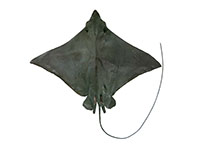
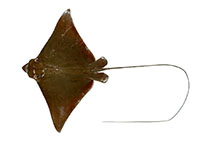
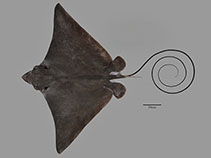
This medium to large-sized Aetobatus (reaching 150 cm DW) possess the following diagnostic characters: uniformly greenish grey to brownish dorsal surfaces, without pale spots or ocelli; long head, ventral length 27.4-31.9% DW; long to very long rostral lobe (longest in adult males) and narrow, tapering evenly to tip; single row of teeth plates, those in lower jaw chevron-shaped; width of lower tooth plate about 2.4 times its width and in about 18 series; 100-104 pectoral-fin radials (excluding propterygial radials anterior of eyes); 88-90 total vertebral centra (including synarcual); pelvic-fin radials 1 (with 2-5 fused elements) +17-18; males mature by about 80 cm DW; born at 33.4-35.2 cm DW (Ref. 94821).
Body shape (shape guide): other (see remarks); Cross section: flattened.
Found in shallow waters at water temperature above 15-17°C; in winter months, the species leave the shallower bays for nearby sea where water temperature is above 15°C brought by the Kuroshio current-derived warm waters (Ref. 94821).
Siklus hidup dan perilaku kawin
Kematangan | Reproduksi, perkembang biakan | Pemijahan | telur-telur | Fekunditas | Larva
White, W.T., K. Furumitsu and A. Yamaguchi, 2013. A new species of Eagle ray Aetobatus narutobiei from the Northwest Pacific: an example of the critical role taxonomy plays in fisheries and ecological sciences. Plos One 8(12)e83785:1-12. (Ref. 94821)
Status IUCN Red List (Ref. 130435: Version 2025-2 (Global))
ancaman kepada manusia
Harmless
penggunaan manusia
Alat, peralatan
laporan khas
muat turun XML
Sumber internet
Estimasi berdasarkan model
Indeks keanekaragaman filogenetik (Acuan
82804): PD
50 = 0.5625 [Uniqueness, from 0.5 = low to 2.0 = high].
Bayesian length-weight: a=0.01000 (0.00244 - 0.04107), b=3.04 (2.81 - 3.27), in cm total length, based on all LWR estimates for this body shape (Ref.
93245).
Tingkat Trofik (Acuan
69278): 3.6 ±0.5 se; based on size and trophs of closest relatives
Kerentanan Penangkapan Ikan (Ref.
59153): Very high vulnerability (83 of 100).
🛈