Classification / Noms
Noms communs | Synonymes | Catalog of Fishes(Genre, Espèce) | ITIS | CoL | WoRMS | Cloffa
>
Perciformes/Cottoidei (Sculpins) >
Cottidae (Sculpins)
Etymology: Cottus: Greek, kottos = a fish (Ref. 45335); schitsuumsh: The specific name schitsu’umsh (pronounced s-CHEET-sue-umsh) is Americanist phonetic notation of the spoken word used by the first peoples who inhabited portions of northern Idaho and western Montana, now recognized as the Coeur d’Alene Tribe. In modern usage it means "those who were found here" and refers to the people of this tribe. The current distribution of this species overlaps with most of the historical homeland of this tribe.
Environnement : milieu / zone climatique / profondeur / gamme de distribution
Écologie
; eau douce benthopélagique. Temperate
North America: Columbia River basin, Idaho-Montana, USA.
Taille / Poids / Âge
Maturité: Lm ? range ? - ? cm
Max length : 9.9 cm SL mâle / non sexé; (Ref. 94998)
Description synthétique
Clés d'identification | Morphologie | Morphométrie
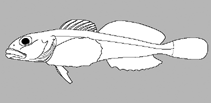
Épines dorsales (Total) : 7 - 9; Rayons mous dorsaux (Total) : 17 - 20; Rayons mous anaux: 13 - 15. Distinguished from all congeners in the upper Columbia River basin by the lack of a second preopercular spine, palatine tooth patches smaller and separate from the vomerine tooth patch, and axillary prickling. Differs from Cottus cognatus, C. confusus , C. hubbsi, and C. rhotheus by the absence of a second preopercular spine; and from C. cf. bairdii and C. beldingii by the presence of axillary prickling. Furthermore, this species possesses palatine tooth patches smaller than the vomerine tooth patch and the patches are separated (vs. palatine tooth patches equal to or larger in size than the vomerine tooth patch in Cottus cf. bairdii; and generally, palatine teeth absent in Cottus beldingii) (Ref. 94998).
Common to abundant in cool to cold tributaries with cobble and gravel bottoms. Sympatric with Oncorhynchus clarkii and Salvelinus confluentus throughout its distribution, with Cottus rhotheus in Idaho, and withCottus cognatu in Montana (Ref. 94998).
Cycle de vie et comportement reproducteur
Maturité | Reproduction | Frai | Œufs | Fécondité | Larves
Lemoine, M., M.K. Young, K.S. Mckelvey, L. Eby, K.L. Pilgrim and M.K. Schwartz, 2014. Cottus schitsuumsh, a new species of sculpin (Scorpaeniformes: Cottidae) in the Columbia River basin, Idaho-Montana, USA. Zootaxa 3755(3):241-258. (Ref. 94998)
Statut dans la liste rouge de l'IUCN (Ref. 130435: Version 2025-2 (Global))
Menace pour l'homme
Harmless
Utilisations par l'homme
Pêcheries: sans intérêt
Outils
Articles particuliers
Télécharger en XML
Sources Internet
Estimations basées sur des modèles
Indice de diversité phylogénétique (Réf.
82804): PD
50 = 0.5000 [Uniqueness, from 0.5 = low to 2.0 = high].
Bayesian length-weight: a=0.00832 (0.00345 - 0.02005), b=3.16 (2.98 - 3.34), in cm total length, based on LWR estimates for this Genus-body shape (Ref.
93245).
Niveau trophique (Réf.
69278): 3.3 ±0.4 se; based on size and trophs of closest relatives
Résilience (Réf.
120179): Milieu, temps minimum de doublement de population : 1,4 à 4,4 années (Preliminary K or Fecundity.).
Vulnérabilité de la pêche (Ref.
59153): Low vulnerability (10 of 100).
🛈