Klassifizierung / Names
Namen | Synonyme | Catalog of Fishes(Gattung, Arten) | ITIS | CoL | WoRMS | Cloffa
>
Gobiiformes (Gobies) >
Gobiidae (Gobies) > Gobiinae
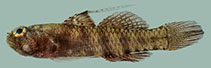
Etymology: Eviota: No etymology given, suggested by Christopher Scharpt: from Latin 'eu' for 'true' and 'iota' for anything very small, in combination 'truly very small' referring to it as being the smallest vertebrate at the time it has benn described by Jenkins (thus, making the suggestion by Scharpt plausible; piperata: Name from Latin 'piper' for pepper; referring to the heavy peppering of melanophores on its head and all over its body (Ref. 94781).
Umwelt: Milieu / Klimazone / Tiefenbereich / Verbreitungsgebiet
Ökologie
seewasser riff-verbunden; tiefenbereich 6 - 9 m (Ref. 94781). Tropical
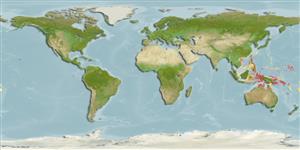
Western Pacific: Palau south to Indonesia (Raja Ampat and the Moluccas), north to Taiwan, including Papua New Guinea; South China Sea to the Philippines Islands (Apo Reef, Mindoro Province, outside of the Sulu Sea).
Größe / Gewicht / Alter
Geschlechtsreife: Lm ? range ? - ? cm
Max length : 2.0 cm SL Männchen/unbestimmt; (Ref. 94781)
Kurzbeschreibung
Bestimmungsschlüssel | Morphologie | Morphometrie
Rückenflossenstacheln (insgesamt) : 7; Rückenflossenweichstrahlen (insgesamt) : 8; Afterflossenstacheln: 1; Afterflossenweichstrahlen: 8; Wirbelzahl: 24. This species is distinguished by the following characters: cephalic sensory-pore system categorized as Group II or without the IT pore, and a varied POP from being both absent to lacking only the upper or lower pore; 8/8 dorsal/anal-fin formula; some branched pectoral-fin rays; absence of dark spot on ural centrum; male genital papilla without fimbria; cheek and rest of body densely peppered with chromatophores (Ref. 94781)
Body shape (shape guide): elongated; Cross section: oval.
Found to be abundant in small coral limestone islands, with small shallow lagoons and steep outer slopes to deepwater, on submerged volcanic peaks (Ref. 94781).
Lebenszyklus und Paarungsverhalten
Geschlechtsreife | Fortpflanzung | Ablaichen | Eier | Fruchtbarkeit | Larven
Greenfield, D.W. and R. Winterbottom, 2014. Eviota piperata, a new gobiid species from Palau (Teleostei: Gobiidae). Zootaxa 3755(3):295-300. (Ref. 94781)
IUCN Rote Liste Status (Ref. 130435: Version 2025-2 (Global))
Bedrohung für Menschen
Harmless
Nutzung durch Menschen
Tools
Zusatzinformationen
Download XML
Internet Quellen
Schätzungen auf der Grundlage von Modellen
Bevorzugte Temperatur (Ref.
123201): 28.8 - 29.4, mean 29 °C (based on 215 cells).
Phylogenetischer Diversitätsindex (Ref.
82804): PD
50 = 0.5000 [Uniqueness, from 0.5 = low to 2.0 = high].
Bayesian length-weight: a=0.00692 (0.00281 - 0.01706), b=3.09 (2.92 - 3.26), in cm total length, based on LWR estimates for this Genus-body shape (Ref.
93245).
Trophische Ebene (Ref.
69278): 3.0 ±0.3 se; based on size and trophs of closest relatives
Widerstandsfähigkeit (Ref.
120179): hoch, Verdopplung der Population dauert weniger als 15 Monate. (Preliminary K or Fecundity.).
Anfälligkeit der Fischerei (Ref.
59153): Low vulnerability (10 of 100).
🛈