Classificação / Nomes
Nomes comuns | Sinônimos | Catalog of Fishes(Gênero, Espécies) | ITIS | CoL | WoRMS | Cloffa
>
Siluriformes (Catfishes) >
Loricariidae (Armored catfishes) > Loricariinae
Etymology: Loricaria: Latin, lorica, loricare = cuirass of corslet of leather; 1706 + Greek, ichthys = fish (Ref. 45335); luciae: Named for Dr. Lúcia H. Rapp Py-Daniel, Curator of Fishes at Instituto Nacional de Pesquisas da Amazônia, for her many contributions Neotropical ichthyology, particularly loricariid taxonomy and systematics.
Eponymy: Dr Lúcia Helena Rapp Py-Daniel is a Brazilian ichthyologist. (See Py-Daniel) (Ref. 128868), visit book page.
Meio ambiente: milieu / Zona climática / intervalo de profundidade / faixa de distribuição
Ecologia
; Água doce demersal. Tropical
South America: throughout the rio Paraguay basin of Bolivia, Brazil, and Paraguay, south to its confluence with the rio Paraná in Argentina.
Tamanho / Peso / Idade
Maturidade: Lm ? range ? - ? cm
Max length : 18.9 cm SL macho/indeterminado; (Ref. 94550)
Descrição suscinta
Chaves de identificação | Morfologia | Morfometria
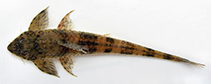
This species can be diagnosed from all congeners, except Loricaria coximensis, L. holmbergi, and L. pumila, by possessing large and tightly joined plates confined to median abdominal space between lateral abdominal plates, with pectoral girdle entirely naked or occasionally with small isolated plates near base of pectoral fin (vs. plates covering the entire median abdominal space and pectoral girdle, usually with a V-shaped anterior margin). It differs from L. pumila by having a larger adult size (13-19 cm vs. less than 8.5 cm SL), iris operculum present (vs. absent), and larger eye size (minimum orbital diameter 16.2- 19.4% vs. usually less than 13.3% of HL); from most similar species L. coximensis and L. holmbergi by having a larger adult size (13-19 cm SL vs. usually less than 13 cm SL) and larger post-ural plate length (17.0-20.3% vs. 7.4-14.2% of HL); and further distinguished from L. coximensis by having 32-33 lateral plates (vs. 28-31) (Ref. 94550).
Body shape (shape guide): elongated.
Facultative air-breathing in the genus (Ref. 126274); Occurs in flowing water habitats ranging from small, seasonally intermittent streams (arroyos) to large permanent rivers. Collected from the following localities: repeatedly in small order streams with clear water in the upper rio Miranda drainage within the boundaries of the Parque Nacional da Serra da Bodoquena; in and above riffles at depths of 0.3-1.5 m in the Aquidaban and Tebicuary drainages; in black water at the edge of the main river channel in swift current over sand and mud substrates in the rio Negro at the southern end of the Pantanal wetlands; along the shore over substrates of sand, silt and mud, at a depth of less than 1.5 m using seine at night in the lower rio Paraná (Ref. 94550).
Ciclo de vida ou comportamento de acasalamento
Maturidade | Reprodução | Desova | Ovos | Fecundidade | Larvas
Thomas, M.R., M.S. Rodriguez, M.R. Cavallaro, O. Froehlich and R.M. Corrêa E Castro, 2013. Loricaria luciae, a new species of whiptail catfish (Siluriformes: Loricariidae) from the Paraguay and lower Paraná River basins of southeastern South America. Zootaxa 3745(3):365-378. (Ref. 94550)
Status na Lista Vermelha da UICN (Ref. 130435: Version 2025-2 (Global))
Ameaça para os humanos
Harmless
Uso pelos humanos
Ferramentas
Relatórios especiais
Baixar XML
Fontes da internet
Estimativas baseadas em modelos
Índice de diversidade filogenética (Ref.
82804): PD
50 = 0.5000 [Uniqueness, from 0.5 = low to 2.0 = high].
Bayesian length-weight: a=0.00398 (0.00185 - 0.00857), b=3.11 (2.93 - 3.29), in cm total length, based on LWR estimates for this (Sub)family-body shape (Ref.
93245).
Nível Trófico (Ref.
69278): 2.5 ±0.2 se; based on size and trophs of closest relatives
Resiliência (Ref.
120179): médio(a), tempo mínimo de duplicação da população 1,4 - 4,4 anos (Preliminary K or Fecundity.).
Vulnerabilidade da pesca (Ref.
59153): Low vulnerability (13 of 100).
🛈