klasifikasi / Nama
Nama-nama umum | Sinonim (persamaan) | Catalog of Fishes(Marga, Jenis) | ITIS | CoL | WoRMS | Cloffa
>
Siluriformes (Catfishes) >
Trichomycteridae (Pencil or parasitic catfishes) > Glanapteryginae
Etymology: Typhlobelus: Greek, typhlos = blind + Greek, belos, -eos, -oys = arrow (Ref. 45335); auriculatus: From a Latin adjective auriculatus, meaning with ears, referring to the conspicuously modified
pseudotympanus in this species.
Lingkungan: lingkungan / zona iklim / kisaran kedalaman / jangkauan distribusi
Ekologi
; air tawar dasar (demersal). Tropical
South America: Lower rio Xingu in Brazil.
Ukuran / Berat / umur
Kematangan: Lm ? range ? - ? cm
Max length : 3.0 cm SL jantan/; (Ref. 94274)
deskripsi pendek
Kunci identifiaksi (pengenalan) | Morfologi | Morfometrik
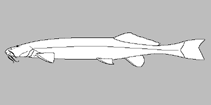
vertebrata, bertulang belakang: 54 - 56. This species can be diagnosed from all other trichomycterids (and, in the case of the former two characters, probably from all other catfishes) by three autapomorphic modifications: the pseudotympanus modified into a tympanic recess, visible as a deep, well-defined depression on the side of the head, and anteriorly connected via a superficial groove to the pterotic; absence of the laterosensory canal system on the body and head (except for the inner ear), reflected externally as a lack of sensory pores (except one modified pore incorporated into the tympanic recess and leading directly into the interior of the pterotic bone); and a supracleithrum not covering any portion of the lateral opening of the swimbladder capsule. It can be further distinguished from all its congeners by the following characters: absence of the anal fin (vs. presence); presence of one or two well-developed opercular odontodes (vs. absence); presence of anteroventral and dorsal processes of the opercle (vs. vestigial and absence, respectively). It further differs from both Typhlobelus macromycterus and T. guacamaya by having 4 branchiostegal rays (vs. 5 and 3, respectively); and from T. guacamaya and T. lundbergi by having some premaxillary teeth (vs. teeth absent) (Ref. 94274).
Body shape (shape guide): eel-like.
Collected during late afternoon at the peak of the southwestern Amazonian summer when rivers are at their lowest level. The site was a marginal sand bank forming a small island. Found in an area with moderate current (approx. 40 cm/sec), depths up to 35 cm, markedly warm water (30-33uC on the surface), horizontal transparency varied between 2.5 and 3.2 m and pH 6.5-7.0.
Siklus hidup dan perilaku kawin
Kematangan | Reproduksi, perkembang biakan | Pemijahan | telur-telur | Fekunditas | Larva
de Pinna, M.C.C. and J. Zuanon, 2013. The genus Typhlobelus: Monopoly and taxonomy, with description of a new species with a unique pseudotympanic structure (Teleostei: Trichomycteridae). Copeia 2013(3):441-453. (Ref. 94274)
Status IUCN Red List (Ref. 130435: Version 2025-2 (Global))
ancaman kepada manusia
Harmless
penggunaan manusia
Alat, peralatan
laporan khas
muat turun XML
Sumber internet
Estimasi berdasarkan model
Indeks keanekaragaman filogenetik (Acuan
82804): PD
50 = 0.5312 [Uniqueness, from 0.5 = low to 2.0 = high].
Bayesian length-weight: a=0.00102 (0.00046 - 0.00225), b=3.06 (2.88 - 3.24), in cm total length, based on all LWR estimates for this body shape (Ref.
93245).
Tingkat Trofik (Acuan
69278): 3.1 ±0.3 se; based on size and trophs of closest relatives
Kerentanan Penangkapan Ikan (Ref.
59153): Low vulnerability (10 of 100).
🛈