>
Lophiiformes (Anglerfishes) >
Chaunacidae (Sea toads o coffinfishes)
Etymology: Chaunax: Greek, chaunax, -akos = a conceited man (Ref. 45335); russatus: Name from Latin 'russatus' or clothed in red; referring to the uniform bright red colour of the body and fins.
Environnement : milieu / zone climatique / profondeur / gamme de distribution
Écologie
marin benthopélagique; profondeur 512 - 1200 m (Ref. 93086). Deep-water
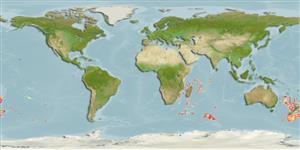
Southwest Pacific: North I. and northern South I. of New Zealand north of the subtropical convergence; from s. Lord Howe Rise, West Norfolk Ridge, s. Kermadec Ridge, n slope of Chatham Rise to e. of Chatham Is. and Louisville Rdige (Ref. 93086). With specimens collected from the western Indian Ocean, it is now thought to exhibit a trans-Indian Ocean distribution (Ref. 94130).
Taille / Poids / Âge
Maturité: Lm ? range ? - ? cm
Max length : 23.3 cm SL mâle / non sexé; (Ref. 93086)
Description synthétique
Clés d'identification | Morphologie | Morphométrie
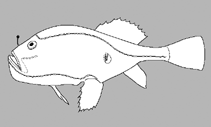
Épines dorsales (Total) : 3; Rayons mous dorsaux (Total) : 12; Rayons mous anaux: 6 - 7. This species which is a member of the C. abei-species group possess a broad illicial trough that is wider than the eye pupil diameter and has a uniformly deep red body; further distinguished from its congeners in having the modally 1spine on each side of lateral-line neuromast; modally 12 pectoral-fin rays; caudal peduncle wide and stout; illicium short and stout; esca large with numerous bright red cirri; greyish gill chamber and gill arches; gill rakers - GRi = 17-18 (3-4+13-15); GRii = 14-15; GRiii = 14-15; GRiv = 12; lateral-line neuromast counts: AB = 11-12 (modally 12); AC = 8; BB' = 4-5 (4); BD = 2-3 (2); CD = 6-7 (7); EF = 4-5 (4); FG = 4-5 (4); GH = 11-14 (13); BI = 32-39 (Ref. 93086).
Body shape (shape guide): short and / or deep; Cross section: flattened.
Cycle de vie et comportement reproducteur
Maturité | Reproduction | Frai | Œufs | Fécondité | Larves
Ho, H.-C., C.D. Roberts and A.L. Stewart, 2013. A review of the anglerfish genus Chaunax (Lophiiformes: Chaunacidae) from New Zealand and adjacent waters, with descriptions of four new species. Zootaxa 3620(1):089-111. (Ref. 93086)
Statut dans la liste rouge de l'IUCN (Ref. 130435: Version 2025-2 (Global))
Menace pour l'homme
Harmless
Utilisations par l'homme
Outils
Articles particuliers
Télécharger en XML
Sources Internet
Estimations basées sur des modèles
Température préférée (Réf.
123201): 2.3 - 8.6, mean 6.8 °C (based on 153 cells).
Indice de diversité phylogénétique (Réf.
82804): PD
50 = 0.5000 [Uniqueness, from 0.5 = low to 2.0 = high].
Bayesian length-weight: a=0.01905 (0.00749 - 0.04850), b=3.02 (2.80 - 3.24), in cm total length, based on LWR estimates for this (Sub)family-body shape (Ref.
93245).
Niveau trophique (Réf.
69278): 4.1 ±0.5 se; based on size and trophs of closest relatives
Vulnérabilité de la pêche (Ref.
59153): Low vulnerability (18 of 100).
🛈