Klassificering / Namn
Populärnamn | synonymer | Catalog of Fishes(Släkte, Arter) | ITIS | CoL | WoRMS | Cloffa
>
Anabantiformes (Gouramies, snakeheads) >
Badidae (Chameleonfishes)
Etymology: Dario: Bengali/Bangla: ‘Darhi’, local Bengali name for this species; ‘Darhi’ also means ‘beard' (Ref. 2031); kajal: Name from the Hindi word 'kajal' meaning black eyeliner, used mainly by traditional Indian dancers; referring to the prominent orbital stripes of the new species.
Miljö: miljö / Klimatzon / djupintervall / distributionsområde
Ekologi
; sötvatten pelagic-neritic. Subtropical
Asia: India.
Storlek / Vikt / Ålder
Könsmognad: Lm ? range ? - ? cm
Max length : 2.0 cm SL hane/ej könsbestämd; (Ref. 94460)
Kort beskrivning
Bestämningsnycklar | Morfologi | Morfometri
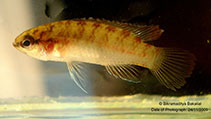
Taggstrålar i ryggfenan (totalt) : 13 - 15; Mjukstrålar i ryggfenan (totalt) : 6 - 8; Taggstrålar i analfenan: 3; Mjukstrålar i analfenan: 6 - 8; Ryggkotor: 24 - 26. This small badid species is distinguished from all its congeners by the following characters: presence of a postorbital stripe that continues behind eye in line with preorbital stripe (vs. postorbital stripe forming an oblique angle with the preorbital stripe in D. dario and D. urops or no postorbital stripe in D. hysginon and D. dayingensis) and males with a series of double bars restricted to the upper half of the body (vs. complete bars across the body in D. dario, complete bars restricted to the posterior body in D. urops and no bars in D. hysginon and D. dayingensis); differs further from D. urops in the absence of a caudal peduncle blotch and a horizontal suborbital stripe, by dorsal-fin lappets in males extending beyond the spine tip (vs. not extending beyond the spine tip) and a lower vertebral number, 24-26 (vs. 28-29); distinguished further from D. urops and D. dayingensis in having a lower transverse scale count, 8 (vs. 9-10) and no palatine teeth (vs. presence); from D. dario by the presence in males of a black spot anteriorly in the dorsal fin and modally 7 (vs. 6) anal-fin rays; from D. hysginon by the absence of an anguloarticular lateral line canal (vs. presence) (Ref. 94460).
Body shape (shape guide): fusiform / normal; Cross section: compressed.
This species is collected from a small, shallow pool with stagnant to slow-flowing water; at the time of collection, the pool was turbid and had no aquatic vegetation (Ref. 94460).
Livscykel och parningsbeteende
Könsmognad | Reproduktion | Lek | Ägg | Fekunditet | Larver
Britz, R. and S.O. Kullander, 2013. Dario kajal, a new species of badid fish from Meghalaya, India (Teleostei: Badidae). Zootaxa 3731(3):331-337. (Ref. 94460)
Status på IUCN:s rödlista (Ref. 130435: Version 2025-2 (Global))
Hot mot människor
Harmless
Mänskliga användningsområden
Verktyg
Särskilda rapporter
Ladda ner XML
Internet-källor
Uppskattningar baserade på modeller
Index för fylogenetisk mångfald (Ref.
82804): PD
50 = 0.5020 [Uniqueness, from 0.5 = low to 2.0 = high].
Bayesian length-weight: a=0.01175 (0.00503 - 0.02745), b=2.93 (2.73 - 3.13), in cm total length, based on LWR estimates for this (Sub)family-body shape (Ref.
93245).
Trofisk nivå (Ref.
69278): 3.0 ±0.4 se; based on size and trophs of closest relatives
Sårbarhet i fisket (Ref.
59153): Low vulnerability (10 of 100).
🛈