Classificazione / Nomi
Nomi Comuni | Sinonimi | Catalog of Fishes(Genere, Specie) | ITIS | CoL | WoRMS | Cloffa
>
Siluriformes (Catfishes) >
Pseudopimelodidae (Bumblebee catfishes, dwarf marbled catfishes) > Batrochoglaninae
Etymology: Microglanis: Greek, mikros = small + Greek, glanis = a fish that can eat the bait without touching the hook; a cat fish (Ref. 45335); lundbergi: Named for the North American ichthyologist John G. Lundberg, coordinator of the Calhamazon project, who kindly provided specimens of the new species, and for his great contribution to the Systematics of Neotropical catfishes.
Eponymy: Dr John Graham Lundberg (d: 1942) is an American ichthyologist. [...] (Ref. 128868), visit book page.
Ambiente: milieu / zona climatica / distribuzione batimetrica / gamma di distribuzione
Ecologia
; acqua dolce demersale. Tropical
South America: Rio Amazonas, near the Madeira and Itacoatiara tributaries, and
from rio Solimões in Brazil.
Dimensione / Peso / Età
Maturità: Lm ? range ? - ? cm
Max length : 2.8 cm SL maschio/sesso non determinato; (Ref. 94156)
Breve descrizione
Chiavi di identificazione | Morfologia | Morfometria
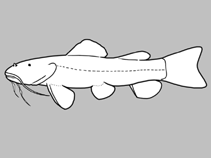
Spine dorsali (totale) : 1; Raggi dorsali molli (totale) : 6; Raggi anali molli: 11; Vertebre: 27. This species differs from all members of the genus Microglanis by having a forked caudal fin with a deep notch between upper and lower lobes, two pale juxtaposed and elliptical spots in the supraoccipital region, and length of the adipose-fin base 13.1-16.6% of SL. It can be separated from other species by the following morphometric characters: length of the head 27.4-30.0% of SL (vs. 24.7-26.4% in M. carlae; 23.9-25.1% in M. iheringi; 23.0-26.1% in M. parahybae; 23.0-25.4% in M. pataxo; 23.5-26.3% in M. robustus); eye diameter 8.0-9.9% of HL (vs. 12.4-17.6% in M. variegatus); interorbital distance 40.4-44.2% of HL (vs. 45.9-51.5% in M. cottoides; 46.5-49.8% in M. leptostriatus; 46.6-48.6% in M. malabarbai; 38.1-39.1% in M. pellopterygius; 50.9-53.1% in M. poecilus); mouth width 38.0-47.3% of HL (vs. 19.0-25.8% in M. cibelae; 17.5-21.9% in M. garavelloi; 20.1-22.6% in M. nigripinnis); predorsal length 35.5-38.6% of SL (vs. 38.9-46.2% in M. eurystoma); lateral line pores 6-8 (vs. 9 in M. ater and M. secundus); principal caudal rays 15 (vs. 14 in M. zonatus) (Ref. 94156).
Body shape (shape guide): elongated.
Found in the main channel of the rio Amazonas (white waters) with bottom rich in organic matter
and pieces of wood (Ref. 94156).
Ciclo vitale e comportamento di accoppiamento
Maturità | Riproduzione | Deposizione | Uova | Fecondità | Larve
Jarduli, L.R. and O.A. Shibatta, 2013. Description of new species of Microglanis (Siluriformes: Pseudopimelodidae) from the Amazon basin, Amazonas State, Brazil. Neotrop. Ichthyol. 11(3):507-512. (Ref. 94156)
Stato della Lista Rossa IUCN (Ref. 130435: Version 2025-2 (Global))
Minaccia per l'uomo
Harmless
Usi umani
Strumenti
Rapporti speciali
Scarica XML
Fonti Internet
Stime basate su modelli
Indice di diversità filogenetica (Fonte Biblio.
82804): PD
50 = 0.5000 [Uniqueness, from 0.5 = low to 2.0 = high].
Bayesian length-weight: a=0.00692 (0.00292 - 0.01638), b=3.12 (2.91 - 3.33), in cm total length, based on LWR estimates for this (Sub)family-body shape (Ref.
93245).
Livello trofico (Fonte Biblio.
69278): 3.2 ±0.4 se; based on size and trophs of closest relatives
Vulnerabilità della pesca (Ref.
59153): Low vulnerability (10 of 100).
🛈