Klassifizierung / Names
Namen | Synonyme | Catalog of Fishes(Gattung, Arten) | ITIS | CoL | WoRMS | Cloffa
>
Gobiiformes (Gobies) >
Gobiidae (Gobies) > Gobiinae
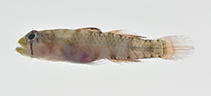
Etymology: Eviota: No etymology given, suggested by Christopher Scharpt: from Latin 'eu' for 'true' and 'iota' for anything very small, in combination 'truly very small' referring to it as being the smallest vertebrate at the time it has benn described by Jenkins (thus, making the suggestion by Scharpt plausible; lacrimosa: Name from Latin 'lacrimosa' meaning tearful or weeping; both scientific and common names refer to the bar below the eye, which is reminiscent of a tear; noun in apposition.
Umwelt: Milieu / Klimazone / Tiefenbereich / Verbreitungsgebiet
Ökologie
seewasser riff-verbunden; tiefenbereich 2 - 36 m (Ref. 94084). Tropical
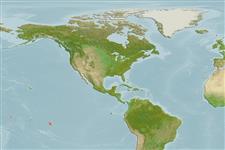
Eastern Central Pacific: known only from the Marquesas Islands, French Polynesia.
Größe / Gewicht / Alter
Geschlechtsreife: Lm ? range ? - ? cm
Max length : 1.0 cm SL Männchen/unbestimmt; (Ref. 94084)
Kurzbeschreibung
Bestimmungsschlüssel | Morphologie | Morphometrie
Rückenflossenstacheln (insgesamt) : 7; Rückenflossenweichstrahlen (insgesamt) : 8; Afterflossenstacheln: 1; Afterflossenweichstrahlen: 7 - 8. This species is characterized by the following set of characters: sensory pore pattern group 2, with only IT pore missing; dorsal/anal ray formula 8/8; some pectoral-fin rays are branched; fifth pelvic-fin ray 1/10-2/10 length of fourth pelvic fin ray; distinct dark vertical stripe on cheek extending ventrally from middle of eye to under lower jaw; urogenital papilla not fimbriate (Ref. 94084).
Body shape (shape guide): elongated; Cross section: oval.
Collected on small coral bommie on sandy slope (Ref. 94084).
Lebenszyklus und Paarungsverhalten
Geschlechtsreife | Fortpflanzung | Ablaichen | Eier | Fruchtbarkeit | Larven
Tornabene, L., G.N. Ahmadia and J.T. Williams, 2013. Four new species of dwarfgobies (Teleostei: Gobiidae: Eviota) from the Austral, Gambier, Marquesas and Society Archipelagos, French Polynesia. Syst. Biodiver. 11(3):363-380. (Ref. 94084)
IUCN Rote Liste Status (Ref. 130435: Version 2025-2 (Global))
Bedrohung für Menschen
Harmless
Nutzung durch Menschen
Tools
Zusatzinformationen
Download XML
Internet Quellen
Schätzungen auf der Grundlage von Modellen
Bevorzugte Temperatur (Ref.
123201): 27.8 - 28.1, mean 28 °C (based on 13 cells).
Phylogenetischer Diversitätsindex (Ref.
82804): PD
50 = 0.5000 [Uniqueness, from 0.5 = low to 2.0 = high].
Bayesian length-weight: a=0.00692 (0.00281 - 0.01706), b=3.09 (2.92 - 3.26), in cm total length, based on LWR estimates for this Genus-body shape (Ref.
93245).
Trophische Ebene (Ref.
69278): 2.9 ±0.3 se; based on size and trophs of closest relatives
Widerstandsfähigkeit (Ref.
120179): hoch, Verdopplung der Population dauert weniger als 15 Monate. (Preliminary K or Fecundity.).
Anfälligkeit der Fischerei (Ref.
59153): Low vulnerability (10 of 100).
🛈