分類 / 名稱
俗名 | 同種異名 | Catalog of Fishes(屬, 種) | ITIS | CoL | WoRMS | Cloffa
Teleostei >
Siluriformes (Catfishes)
鯰形目 (Catfishes) >
Loricariidae (Armored catfishes)
甲鯰科 (Armored catfishes) > Hypostominae
Etymology: Hypostomus: Greek, hypo = under + Greek, stoma = mouth (Ref. 45335); jaguar: Derived from 'îagûara' in the indigenous language Tupi- Guarani, which means panther, in reference to the black dotted color pattern on a clear background. A noun in apposition.
環境: 環境 / 氣候帶 / 深度上下限 / 配送範圍
生態學
; 淡水 居於水底的.
South America: Rio Paraguaçu basin in Bahia State, Brazil.
大小 / 重量 / 年齡
成熟度: Lm ? range ? - ? cm
Max length : 17.6 cm SL 雄魚/尚未辨別雌雄; (Ref. 93813)
簡短描述
檢索表 | 型態特徵 | 形態測量圖
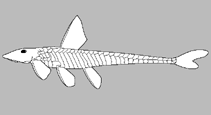
背棘 (總數) : 2; 背的軟條 (總數) : 7; 臀鰭軟條: 4 - 5; 脊椎骨: 29. This species is distinguished from its syntopic congener Hypostomus chrysostiktos by having dorsal fin with 7 unbranched rays (vs. 10-11), large dark dots on a clear background (vs. small yellow dots on a dark background); and median plates 25 or 26 (vs. 27-29). It differs from H. brevicauda and H. wuchereri by possessing the following characters: head and trunk covered by conspicuous dark dots similar in size, ranging from half to approximately one eye diameter (vs. dots smaller than the pupil); interradial membranes of anteriormost dorsal-fin rays with one series of dots (vs. membranes with two or three series of dots); and ventral surface of body comparatively weakly covered by plates, with coverage when present restricted to anterior portion of abdomen (vs. ventral surface almost or completely covered by plates, including the central area between pelvic fins). It can be diagnosed from H. unae by the presence of conspicuous dots on head, trunk, and fins similar in size (vs. dots on lateral of trunk inconspicuous and, when visible, much larger than those on the head and fins), pectoral spine not distinctly strong with a few elongated odontodes on its distal third (vs. pectoral spine distinctly strong with many elongated and curved odontodes on its distal half), dorsal fin with tip of last ray, usually reaching preadipose plate or adipose spine when adpressed (adpressed fin 36.6-44.3% vs. 29.6-38.7% and tip of last rays not reaching adipose plate or spine), 47-86 teeth on premaxilla (vs. 29-70), and 50-81 dentary teeth (vs. 34-89). It differs from its congeners from coastal northeastern rivers (H. carvalhoi, H. eptingi, H. jaguribensis, H. nudiventris, H. papariae, and H. pusarum) by a series of characters, including the dark conspicuous dotted color pattern of the body and fins, ventral surface of the belly comparatively weakly covered by plates, and lobes of the caudal fin relatively similarly elongated (Ref. 93813).
Body shape (shape guide): elongated.
Facultative air-breathing in the genus (Ref. 126274); Occurs in rio Paraguaçu and its tributaries, in stretches of up to 60 m wide and 1.5 m deep, with rocky bottom, dark colored water, mild to fast water current, and at altitudes ranging from 143 to 350 meters above sea level. Sympatric with Hypostomus chrysostiktos (Ref. 93813).
生命週期和交配行為
成熟度 | 繁殖 | 產卵場 | 卵 | 孕卵數 | 仔魚
Zanata, A.M., B. Sardeiro and C.H. Zawadzki, 2013. A new dark-dotted species of Hypostomus Lacépède (Siluriformes: Loricariidae) from rio Paraguaçu, Bahia State, Brazil. Neotrop. Ichthyol. 11(2):247-256. (Ref. 93813)
IUCN 瀕危狀態 (Ref. 130435: Version 2025-2 (Global))
無危 (LC) ; Date assessed: 07 November 2018
人類使用
漁業: 沒有興趣
工具
特別的報告
下載 XML
網路資源
基於模型的估計
系統發育多樣性指數 (參考文獻
82804): PD
50 = 0.5000 [Uniqueness, from 0.5 = low to 2.0 = high].
Bayesian length-weight: a=0.01585 (0.00726 - 0.03460), b=2.95 (2.78 - 3.12), in cm total length, based on LWR estimates for this Genus-body shape (Ref.
93245).
回復力 (參考文獻
120179): 中等的, 族群倍增時間最少 1.4 - 4.4年 (Preliminary K or Fecundity.).
釣魚的脆弱性 (Ref.
59153): Low vulnerability (11 of 100).
🛈