>
Beloniformes (Needle fishes) >
Adrianichthyidae (Ricefishes) > Oryziinae
Etymology: Oryzias: Greek, oryza = rice; because of the habitat used by this fish (Ref. 45335); asinua: Name denotes the occurrence of this species in the Sungai Asinua, the type locality.
Entorno: milieu / zona climática / rango de profundidad / gama de distribución
Ecología
; agua dulce bentopelágico. Tropical; 26°C - ? (Ref. 94271)
Asia: Sungai Asinua in Sulawesi Tenggara, Indonesia.
Tamaño / Peso / Edad
Madurez: Lm ? range ? - ? cm
Max length : 2.7 cm SL macho / no sexado; (Ref. 94271)
Descripción breve
Claves de identificación | Morfología | Morfometría
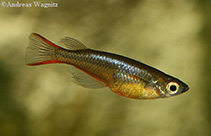
Radios blandos dorsales (total) : 7 - 9; Radios blandos anales: 17 - 19; Vértebra: 29 - 30. A member of Oryzias woworae-species group, which is distinguished by having orange to deep red dorsal and ventral margins of the caudal fin and the ventral margin of the caudal peduncle and at least the posterior portion of the base of the anal fin, and a bluish sheen on the body in both sexes that is most pronounced in live adult males. Oryzias asinua and O. wolasi, differ from O. woworae by having elongate middle dorsal-fin rays in males that reach the posterior extent of the first principal caudal-fin ray and an orange-colored olfactory epithelium that marks each nasal organ in at least females in life. Oryzias asinua can be further diagnosed by having the following characters: an orange-colored olfactory epithelium in both males and females in life and in preserved specimens; relatively slender body compared to O. wolasi and O. woworae with body depth 21-25, mean 22.9 % of SL (vs. 23-32, mean 25.3 in O. wolasi and 22-30, mean 26 in O. woworae); and 4-5 procurrent caudal-fin rays in the lower lobe (vs. 5-7 in O. wolasi and 5-6 in O. woworae) (Ref. 94271).
Body shape (shape guide): elongated.
Found in small pools and along the shore that was an extensive floodplain with clear water, slow to swift current and temperature of 26°C. Lives with a native species of halfbeak, Nomorhamphus sp., a possibly native Clarias sp., and the exotics Puntius binotatus, Trichopodus trichopterus, and Oreochromis sp. (Ref. 94271).
Ciclo vital y comportamiento de apareamiento
Madurez | Reproducción | Puesta | Huevos | Fecundidad | Larva
Parenti, L.R., R.K. Hadiaty, D. Lumbantobing and F. Herder, 2013. Two new ricefishes of the genus Oryzias (Atheirnomorpha: Beloniformes: Adrianichthyidae) augment the endemic freshwater fish fauna of southeastern Sulawesi, Indonesia. Copeia 2013(3):403-414. (Ref. 94271)
Situación en la Lista Roja de la UICN (Ref. 130435: Version 2025-2 (Global))
Amenaza para el ser humano
Harmless
Usos humanos
Pesquerías: sin interés
Herramientas
Informes especiales
Descargar XML
Fuentes de Internet
Estimaciones basadas en modelos
Índice de diversidad filogenética (Referencia
82804): PD
50 = 0.5000 [Uniqueness, from 0.5 = low to 2.0 = high].
Bayesian length-weight: a=0.00479 (0.00190 - 0.01207), b=3.13 (2.91 - 3.35), in cm total length, based on LWR estimates for this (Sub)family-body shape (Ref.
93245).
Nivel trófico (Referencia
69278): 3.2 ±0.4 se; based on size and trophs of closest relatives
Resiliencia (Referencia
120179): Bajo, población duplicada en un tiempo mínimo de 4.5-14 años (Assuming fec < 100).
Vulnerabilidad pesquera (Ref.
59153): Low vulnerability (10 of 100).
🛈