Classificação / Nomes
Nomes comuns | Sinônimos | Catalog of Fishes(Gênero, Espécies) | ITIS | CoL | WoRMS | Cloffa
>
Beloniformes (Needle fishes) >
Zenarchopteridae (Internally fertilized halfbeaks)
Etymology: Hemirhamphodon: Greek, hemi = half + Greek, rhamphos = bill + greek, odous = teeth (Ref. 45335); sesamum: Name refers to the minute oily seeds of the Sesamum plant (Pedaliaceae), in allusion to the small black spots/dashes on the dorsal fi n with which resemble black sesame seeds. A noun in apposition.
Meio ambiente: milieu / Zona climática / intervalo de profundidade / faixa de distribuição
Ecologia
; Água doce pelágico(a,os,as); intervalo de profundidade 0 - ? m. Tropical
Asia: Batulicin and Cantung basins in south Kalimantan, Indonesian Borneo.
Tamanho / Peso / Idade
Maturidade: Lm ? range ? - ? cm
Max length : 4.7 cm SL macho/indeterminado; (Ref. 94086)
Descrição suscinta
Chaves de identificação | Morfologia | Morfometria
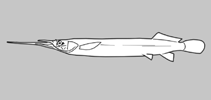
Raios dorsais (total) : 13 - 14; Raios anais : 8; Vértebras: 38 - 41. Distinguished from all congeners in having the following characters: 1) Dorsal fin with melanophores in two distinct sizes. For males in life, first 6 to 7 rays distal one-third to half with yellow suffused throughout the rays and interradial membrane, with iridescent red margin; intense black pigments on the mid-section of interradial membrane between first 3 rays; red pigments on the mid-section of interradial membrane between 6 to 11 rays; rest of fin hyaline. For males in preservative, color pattern as above, but the iridescent red margin is absent. For females in life, first 6 to 7 rays suffused with pale yellow, with iridescent red margin; small patches of black pigments on the middle section of the interradial membrane of first 6 to 7 rays; rest of fin hyaline. For females in preservative, color pattern as above, but the iridescent red margin is absent. Black patches on anterior portion of dorsal fin present in specimens
20 mm SL or larger. 2) Unique dorsal fin morphology in the males - distal portions of first 6 to 7 rays elongated, free of interradial membrane, projected into filaments up to twice the depth of the dorsal fin; adpressed fin rays reaching caudal-fin base and beyond. 3) Unique coloration on lower jaw. For males in life , upper jaw with corresponding portion of lower jaw yellow; dorsal surface of exposed lower jaw bluish, dermal flange below middle section of lower jaw bright red with blue lower margin, tip of lower jaw to region below upper jaw red; dermal flange of lower jaw with distinct black ventral margin from tip to region directly below eye. Males in preservative, exhibit similar color pattern but colors are subdued or faded. Females in life have similar color pattern as male but colors are comparatively less intense. For females in preservative, the red band on the dermal flange of the lower jaw is replaced by yellow. 4) Males with the fourth anal-fin ray distinctly enlarged, and third, fourth and eighth anal-fin rays branched; females with third and fourth anal-fin rays branched. 5) Pelvic-fin origin anterior to dorsal-fin origin. 6) Dorsal-fin rays 13 or 14 (Ref. 94086).
Body shape (shape guide): elongated.
Ciclo de vida ou comportamento de acasalamento
Maturidade | Reprodução | Desova | Ovos | Fecundidade | Larvas
Tan, H.H. and K.K. Lim, 2013. Three new species of freshwater halfbreaks (Teleostei: Zenarchopteridae: Hemirhamphodon) from Borneo. The Raffles Bulletin of Zoology 61(2):735-747. (Ref. 94086)
Status na Lista Vermelha da UICN (Ref. 130435: Version 2025-2 (Global))
Ameaça para os humanos
Harmless
Uso pelos humanos
Ferramentas
Relatórios especiais
Baixar XML
Fontes da internet
Estimativas baseadas em modelos
Índice de diversidade filogenética (Ref.
82804): PD
50 = 0.5020 [Uniqueness, from 0.5 = low to 2.0 = high].
Bayesian length-weight: a=0.00457 (0.00198 - 0.01053), b=3.03 (2.83 - 3.23), in cm total length, based on LWR estimates for this (Sub)family-body shape (Ref.
93245).
Nível Trófico (Ref.
69278): 3.1 ±0.4 se; based on size and trophs of closest relatives
Vulnerabilidade da pesca (Ref.
59153): Low vulnerability (10 of 100).
🛈