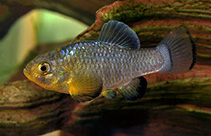
Klassifizierung / Names
Namen | Synonyme | Catalog of Fishes(Gattung, Arten) | ITIS | CoL | WoRMS | Cloffa
>
Cyprinodontiformes (Rivulines, killifishes and live bearers) >
Cyprinodontidae (Pupfishes) > Cyprinodontinae
Etymology: Cyprinodon: Latin, cyprinus = carp + Greek, odous = teeth (Ref. 45335); brontotheroides: Name denotes the resemblance of the unique protruding nasal region in this species to the bizarre horn-like skull appendages of the extinct odd-toed ungulate family Brontotheriidae.
Umwelt: Milieu / Klimazone / Tiefenbereich / Verbreitungsgebiet
Ökologie
; süßwasser benthopelagisch. Tropical
Central America: restricted to six hypersaline lakes on San Salvador Island, Bahamas: Crescent Pond, Osprey Lake, Oyster Lake, Little Lake, Wild Dilly Pond and Moon Rock Pond.
Größe / Gewicht / Alter
Geschlechtsreife: Lm ? range ? - ? cm
Max length : 3.6 cm SL Männchen/unbestimmt; (Ref. 94405)
Kurzbeschreibung
Bestimmungsschlüssel | Morphologie | Morphometrie
Rückenflossenweichstrahlen (insgesamt) : 11 - 12; Afterflossenweichstrahlen: 11 - 12. Distinguished from two other Cyprinodon species on San Salvador Island by the following characters: anterior process of the maxillary head extends up to or beyond the most anterior point on the dentigerous arm of the premaxilla with oral jaws retracted (vs. most anterior point on the maxillary head is always posterior to the most anterior point on the dentigerous arm of the premaxilla in C. variegatus and C. desquamator); externally, this skeletal extension presents as a fleshy protuberance nearly encasing the upper jaw when retracted (vs. lacking any fleshy protuberance surrounding the maxillary head in C. variegatus and C. desquamatory); paired nasal bones are not enlarged, but form a more acute angle (approximately 120") with the dorsal margin of the neurocranium (vs. approximately 180" in C. variegatus and C. desquamatory); with either pale or complete absence of banding along the body in both sexes and shortened lower jaws jaws relative to C. variegates and C. desquamator, which always show dark banding along the body and either typical jaw length for the genus or enlarged jaws, respectively (Ref. 94405).
Inhabits six hypersaline lakes (Crescent Pond, Osprey Lake, Oyster Lake, Little Lake,
Wild Dilly Pond and Moon Rock Pond). Sympatric with Cyprinodon variegatus in all six lakes and with C. desquamator in four of the six lakes (except Wild Dilly Pond and Moon Rock Pond). Feeds on gastropods and ostracods. Spawning occurs in spring and summer seasons, but may be more more common in the spring. Breeding territories are guared by males (Ref. 94405).
Lebenszyklus und Paarungsverhalten
Geschlechtsreife | Fortpflanzung | Ablaichen | Eier | Fruchtbarkeit | Larven
Martin, C.H. and P.C. Wainright, 2013. A remarkable species flock of Cyprinodon pupfishes endemic to San Salvador Island, Bahamas. Bulletin of the Peabody Museum of Natural History 54(2):231-240. (Ref. 94405)
IUCN Rote Liste Status (Ref. 130435: Version 2025-2 (Global))
Bedrohung für Menschen
Harmless
Nutzung durch Menschen
Tools
Zusatzinformationen
Download XML
Internet Quellen
Schätzungen auf der Grundlage von Modellen
Phylogenetischer Diversitätsindex (Ref.
82804): PD
50 = 0.5000 [Uniqueness, from 0.5 = low to 2.0 = high].
Bayesian length-weight: a=0.01349 (0.00599 - 0.03039), b=3.14 (2.95 - 3.33), in cm total length, based on LWR estimates for this (Sub)family-body shape (Ref.
93245).
Trophische Ebene (Ref.
69278): 2.7 ±0.2 se; based on size and trophs of closest relatives
Anfälligkeit der Fischerei (Ref.
59153): Low vulnerability (10 of 100).
🛈