Klassifizierung / Names
Namen | Synonyme | Catalog of Fishes(Gattung, Arten) | ITIS | CoL | WoRMS | Cloffa
>
Cyprinodontiformes (Rivulines, killifishes and live bearers) >
Cyprinodontidae (Pupfishes) > Cyprinodontinae
Etymology: Cyprinodon: Latin, cyprinus = carp + Greek, odous = teeth (Ref. 45335); desquamator: Name from the Latin verb squamare, for one who removes scales from fishes. A noun in apposition.
Umwelt: Milieu / Klimazone / Tiefenbereich / Verbreitungsgebiet
Ökologie
; süßwasser benthopelagisch. Tropical
Central America: restricted to six hypersaline lakes on San Salvador Island, Bahamas: Crescent Pond, Osprey Lake, Oyster Lake, Little Lake, Mermaid Pond and Great Lake.
Größe / Gewicht / Alter
Geschlechtsreife: Lm ? range ? - ? cm
Max length : 3.1 cm SL Männchen/unbestimmt; (Ref. 94405)
Kurzbeschreibung
Bestimmungsschlüssel | Morphologie | Morphometrie
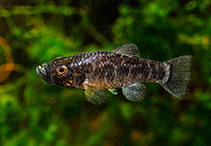
Rückenflossenweichstrahlen (insgesamt) : 11 - 12; Afterflossenweichstrahlen: 10 - 12. Distinguished by having large supra-terminal jaws, elongated body and solid black coloration throughout the entire body and median fins in adult males (Ref. 94405).
Inhabits six hypersaline lakes (Crescent Pond, Osprey Lake, Oyster Lake, Little Lake, Mermaid Pond and Great Lake). Sympatric with Cyprinodon variegatus in all six lakes and with C. brontotheroides in four of the six lakes (except Great Lake and Mermaid Pond). These lakes are shallow, rarely exceeding 3 m depth, and densities of Cyprinodon are greatest in mats of macroalgae (Batophora, Acetabularia and Cladophora) and wigeongrass (Ruppia maritima) along the littoral margins of each lake. Feeds on scales of other fishes. Spawning occurs in spring and summer seasons, but it seems to be more common in the summer. Breeding territories are guarded by males (Ref. 94405).
Lebenszyklus und Paarungsverhalten
Geschlechtsreife | Fortpflanzung | Ablaichen | Eier | Fruchtbarkeit | Larven
Martin, C.H. and P.C. Wainright, 2013. A remarkable species flock of Cyprinodon pupfishes endemic to San Salvador Island, Bahamas. Bulletin of the Peabody Museum of Natural History 54(2):231-240. (Ref. 94405)
IUCN Rote Liste Status (Ref. 130435: Version 2025-2 (Global))
Bedrohung für Menschen
Harmless
Nutzung durch Menschen
Tools
Zusatzinformationen
Download XML
Internet Quellen
Schätzungen auf der Grundlage von Modellen
Phylogenetischer Diversitätsindex (Ref.
82804): PD
50 = 0.5000 [Uniqueness, from 0.5 = low to 2.0 = high].
Bayesian length-weight: a=0.01349 (0.00599 - 0.03039), b=3.14 (2.95 - 3.33), in cm total length, based on LWR estimates for this (Sub)family-body shape (Ref.
93245).
Trophische Ebene (Ref.
69278): 2.8 ±0.2 se; based on size and trophs of closest relatives
Anfälligkeit der Fischerei (Ref.
59153): Low vulnerability (10 of 100).
🛈