Classificação / Nomes
Nomes comuns | Sinônimos | Catalog of Fishes(Gênero, Espécies) | ITIS | CoL | WoRMS | Cloffa
>
Gobiiformes (Gobies) >
Butidae (Gudgeon gobies)
Etymology: Oxyeleotris: Greek, oxys = sharp + The name of a Nile fish, eleotris (Ref. 45335); colasi: Named for COLAS Companies in Indonesia which sponsored, among others, the Lengguru-Kaimana expedition in October-November 2010.
Eponymy: The COLAS Group of companies in Indonesia, which co-sponsored the Lengguru-Kaimana expedition (2010), during which the holotype was collected. (Ref. 128868), visit book page.
Meio ambiente: milieu / Zona climática / intervalo de profundidade / faixa de distribuição
Ecologia
; Água doce demersal. Tropical
Asia: Indonesia.
Tamanho / Peso / Idade
Maturidade: Lm ? range ? - ? cm
Max length : 4.3 cm SL macho/indeterminado; (Ref. 93235)
Descrição suscinta
Chaves de identificação | Morfologia | Morfometria
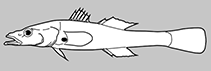
Espinhos dorsais (total) : 7; Raios dorsais (total) : 9 - 11; Espinhos anais: 1; Raios anais : 8 - 9; Vértebras: 26. This species differs from all of its congeners by the combination of the following characters: absence of eyes; total depigmentation on skin and fins; well developed sensory papillae system, with a marked relief on snout, preorbital region, anteriormost part of chin and consisting of low fleshy ridges on each side of the head; sometimes one or two vertical rows of papilla on the body, laterally, behind the pectoral fins; cephalic sensory pores reduced (see Figure 2 & 3 of original publication), pores F, I, J, K, and L absent, no extra pores between D and E; pores A, B, C and D, always present as N, O, P; pores H and M absent on some specimens (M sometimes missing on one side of the fish but not on the other), pores E, G, rarely present; dorsal rays VI-I,9 to 11; anal rays I,8-9; cycloid scales dorsally, covering the belly and extending from the posterior part of the head to the flanks to the middle of first dorsal fin; ctenoid scales on flanks from the middle of first dorsal fin to caudal peduncle; 47-49 lateral scales; 19 transverse scales; 30-32 predorsal scales; anterior-most predorsal scales extending until middle of head; 23-25 circumpeduncular scales; 13 gillrakers; 10 + 16 = 26 vertebrae; head length 38.1-39.7% of SL; snout length 7.2-7.4% of SL; upper jaw length,13.4-14.0% SL; mouth width 8.5-11.4% SL; anterior body depth 16.0-18.8% SL and body width 17.0-18.1% of SL; caudal peduncle length 22.5-24.0 % SL and depth 10.8-11.9% of SL; predorsal length 46.1-47.1% of SL; prepectoral length 39.2-41.3% of SL; pectoral fin length 23.9-26.7% SL (Ref. 93235).
Body shape (shape guide): elongated.
Facultative air-breathing in the genus (Ref. 126274)
Ciclo de vida ou comportamento de acasalamento
Maturidade | Reprodução | Desova | Ovos | Fecundidade | Larvas
Pouyaud, L., [N.] Kadarusman, R.K. Hadiaty, J. Slembrouck, N. Lemauk, R.V. Kusumah and P. Keith, 2012. Oxyeleotris colasi, (Teleostei: Eleotridae), a new blind cave fish from Lengguru in West Papua, Indonesia. Cybium 36(4):521-529. (Ref. 93235)
Status na Lista Vermelha da UICN (Ref. 130435: Version 2025-2 (Global))
Ameaça para os humanos
Harmless
Uso pelos humanos
Ferramentas
Relatórios especiais
Baixar XML
Fontes da internet
Estimativas baseadas em modelos
Índice de diversidade filogenética (Ref.
82804): PD
50 = 0.5000 [Uniqueness, from 0.5 = low to 2.0 = high].
Bayesian length-weight: a=0.00661 (0.00283 - 0.01543), b=3.13 (2.93 - 3.33), in cm total length, based on LWR estimates for this (Sub)family-body shape (Ref.
93245).
Nível Trófico (Ref.
69278): 3.2 ±0.6 se; based on size and trophs of closest relatives
Resiliência (Ref.
120179): Elevada, tempo mínimo de duplicação da população menor que 15 meses (Preliminary K or Fecundity.).
Vulnerabilidade da pesca (Ref.
59153): Low vulnerability (10 of 100).
🛈