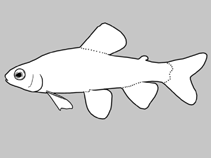
Klassificering / Namn
Populärnamn | synonymer | Catalog of Fishes(Släkte, Arter) | ITIS | CoL | WoRMS | Cloffa
>
Characiformes (Characins) >
Crenuchidae (South American darters) > Characidiinae
Etymology: Characidium: Diminutive of Charax, -akos = a fish without identification (Ref. 45335); papachibe: The name is a reference to 'papa-chibé, a traditional name associated with the State of Pará natives, and pays homage to the people of Pará.
Eponymy: Papa-chibé is a name traditionally associated with people from the Brazilian state of Pará, which is where this species occurs. (Ref. 128868), visit book page.
Miljö: miljö / Klimatzon / djupintervall / distributionsområde
Ekologi
; sötvatten bentopelagisk; pH range: 6.2 - 6.3; djupintervall 1 - 2 m (Ref. 93226). Tropical; 25°C - 27°C (Ref. 93226)
South America: Rio Aruã, tributary of the Rio Tapajós basin, lower Amazon in Brazil.
Storlek / Vikt / Ålder
Könsmognad: Lm ? range ? - ? cm
Max length : 2.7 cm SL hane/ej könsbestämd; (Ref. 93226)
Kort beskrivning
Bestämningsnycklar | Morfologi | Morfometri
Mjukstrålar i ryggfenan (totalt) : 12 - 13; Mjukstrålar i analfenan: 8 - 9; Ryggkotor: 34. It is diagnosed from other species of Characidium, except C. serrano and C. heirmostigmata, by having anteriorly oblique, midlateral bands centered on lateral line or just ventral thereof and not reaching either the dorsum or the ventrum, anterior bands. It differs from from C. serrano and C. heirmostigmata by having the following characters: 3 scales above and 3 below the lateral line (vs. 4 or 5 above and 4 or 5 below the lateral line in C. serrano and C. heirmostigmata); 10 scales around the caudal peduncle (vs. 12 in C. serrano and C. heirmostigmata); and snout length 15.0-18.8% HL (vs. 23.4-26.9% HL in C. serrano and 20.3- 27.8% HL in C. heirmostigmata). It can be further distinguished from C. heirmostigmata by having 12-15 oblique bars (vs. 8-11), 8 or 9 anal-fin rays (vs. 10 or 11), 10 or 11 pectoral-fin rays (vs. 13 or 14), and head length 25.7-29.2% SL (vs. 22.4-24.6% SL). It can be further separated from C. serrano by having 29-33 scales on the lateral line (vs. 37-39) and interorbital distance 19.0-25.0% HL (vs. 11.9-17.2 HL). This species is slightly similar to the psammophile species C. heinianum, C. longum, C. pellucidum, and C. pteroides because of its reticulated color pattern. However, it is distinguished from those species by the presence of the anteriorly oblique bars. It can be further distinguished from C. longum by having 10 or 11 pectoral-fin rays (vs. 13 or 14), 10 scale series around the caudal peduncle (vs. 12), body depth at dorsal-fin origin 18.9-25.7% SL (vs. 9.3-15.8% SL), and body depth at anal-fin origin 12.2-17.8% SL (vs. 7.5-11.0% SL); from another psammophile species, Geryichthys sterbai, by the presence of the adipose fin (vs. absence), by the presence of ectopterygoid teeth (vs. absence), by the 10 scale series around the caudal peduncle (vs. 12); and by absence of rhomboidal bars (vs. presence) (Ref. 93226).
Body shape (shape guide): fusiform / normal.
Inhabits stream with shallow margins about 1-1.8 m deep, dense aquatic vegetation, sandy bottom and margins composed of decaying plant matter (Ref. 93226).
Livscykel och parningsbeteende
Könsmognad | Reproduktion | Lek | Ägg | Fekunditet | Larver
Peixoto, L.A.W. and W.B. Wosiacki, 2013. A new species of Characidium Agassiz (Characiformes: Crenuchidae) from the Lower Amazon. Copeia 2013(1):52-57. (Ref. 93226)
Status på IUCN:s rödlista (Ref. 130435: Version 2025-2 (Global))
Hot mot människor
Harmless
Mänskliga användningsområden
Verktyg
Särskilda rapporter
Ladda ner XML
Internet-källor
Uppskattningar baserade på modeller
Index för fylogenetisk mångfald (Ref.
82804): PD
50 = 0.5000 [Uniqueness, from 0.5 = low to 2.0 = high].
Bayesian length-weight: a=0.01122 (0.00514 - 0.02450), b=3.04 (2.87 - 3.21), in cm total length, based on all LWR estimates for this body shape (Ref.
93245).
Trofisk nivå (Ref.
69278): 3.2 ±0.3 se; based on size and trophs of closest relatives
Sårbarhet i fisket (Ref.
59153): Low vulnerability (10 of 100).
🛈