Klassifizierung / Names
Namen | Synonyme | Catalog of Fishes(Gattung, Arten) | ITIS | CoL | WoRMS | Cloffa
>
Eupercaria/misc (Various families in series Eupercaria) >
Lutjanidae (Snappers) > Caesioninae
Etymology: Caesio: Latin, caesius, bluish-grey, 1835; it is the same name given to the silvery metal (Cs) (Ref. 45335); xanthalytos: Name from Greek, literally meaning 'yellow line'; referring to the prominent deep yellow band along the fish’s midside; noun in apposition.
Umwelt: Milieu / Klimazone / Tiefenbereich / Verbreitungsgebiet
Ökologie
seewasser; brackwasser pelagic-neritic; tiefenbereich 8 - 40 m (Ref. 94071). Tropical
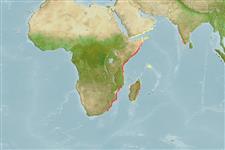
Western Indian Ocean: Kenya (purchased in Mombasa market), Tanzania (Dar es Salaam), southern Mozambique and KwaZulu-Natal (Margate, 30°51' S), southern Madagascar (Ref. 94071); and a new record from the Laccadive Arch. (Ref. 130907).
Größe / Gewicht / Alter
Geschlechtsreife: Lm ? range ? - ? cm
Max length : 22.0 cm SL Männchen/unbestimmt; (Ref. 94071)
Kurzbeschreibung
Bestimmungsschlüssel | Morphologie | Morphometrie
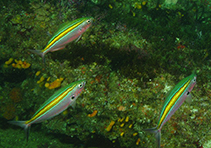
Rückenflossenstacheln (insgesamt) : 10; Rückenflossenweichstrahlen (insgesamt) : 15; Afterflossenstacheln: 3; Afterflossenweichstrahlen: 11 - 12; Wirbelzahl: 23. This medium-sized species is distinguished by the following: a prominent, composite, yellow lateral band in life, bordered by irregular dark brown stripes, and with a narrow blue stripe in the yellow, above the lateral line; the lateral line is within band for most of length; 19-22 pectoral-fin rays (rarely 19 or 21, 22); 57-67 (mode 59-62) lateral line scales; 11-12 (mode 11) anal fin rays; 8 + 12 circumpeduncular scales (Ref. 94071).
Body shape (shape guide): fusiform / normal; Cross section: compressed.
This species schools with Caesio variliniata and both have been observed together in large shoals in northern KwaZulu-Natal. Prolific spawning in the Park Rynie area, KwaZulu-Natal (30°20’ S, 30°45’ E) is apparent due to abundance of eggs of this species from plankton collections (Ref. 94071).
Lebenszyklus und Paarungsverhalten
Geschlechtsreife | Fortpflanzung | Ablaichen | Eier | Fruchtbarkeit | Larven
Holleman, W., A.D, Connell and K.E. Carpenter, 2013. Caesio xanthalytos, a new species of fusilier (Perciformes: Caesionidae) from the Western Indian Ocean, with records of range extensions for several species of Caesionidae. Zootaxa 3702(3):262-272. (Ref. 94071)
IUCN Rote Liste Status (Ref. 130435: Version 2025-2 (Global))
Bedrohung für Menschen
Harmless
Nutzung durch Menschen
Fischereien: kommerziell
Tools
Zusatzinformationen
Download XML
Internet Quellen
Schätzungen auf der Grundlage von Modellen
Bevorzugte Temperatur (Ref.
123201): 24.7 - 27.5, mean 26.7 °C (based on 42 cells).
Phylogenetischer Diversitätsindex (Ref.
82804): PD
50 = 0.5010 [Uniqueness, from 0.5 = low to 2.0 = high].
Bayesian length-weight: a=0.01202 (0.00536 - 0.02697), b=3.07 (2.88 - 3.26), in cm total length, based on LWR estimates for this (Sub)family-body shape (Ref.
93245).
Trophische Ebene (Ref.
69278): 3.4 ±0.4 se; based on size and trophs of closest relatives
Widerstandsfähigkeit (Ref.
120179): hoch, Verdopplung der Population dauert weniger als 15 Monate. (Preliminary K or Fecundity.).
Anfälligkeit der Fischerei (Ref.
59153): Low vulnerability (17 of 100).
🛈