Clasificación / Nombres
Nombres comunes | Sinónimos | Catalog of Fishes(Género, Especie) | ITIS | CoL | WoRMS | Cloffa
>
Cyprinodontiformes (Rivulines, killifishes and live bearers) >
Nothobranchiidae (African rivulines)
Etymology: Epiplatys: Greek, epi = over, in front + Greek, platys = flat (Ref. 45335); atratus: The species name, atratus, means "clothed in black", from the Latin "ater" (black), referring to adult dominant males that have an almost black appearance in ethanol (Ref. 94049).
Entorno: milieu / zona climática / rango de profundidad / gama de distribución
Ecología
; agua dulce pelágico; pH range: 4.5 - 6.6. Tropical; 24°C - 30°C (Ref. 94049)
Africa: restricted to the middle Lulua River (middle Congo River basin) in Democratic Republic of the Congo (Ref. 94049).
Tamaño / Peso / Edad
Madurez: Lm ? range ? - ? cm
Max length : 4.3 cm SL macho / no sexado; (Ref. 94049)
Descripción breve
Claves de identificación | Morfología | Morfometría
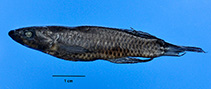
Espinas dorsales (total) : 0; Radios blandos dorsales (total) : 9 - 10; Espinas anales: 0; Radios blandos anales: 13 - 14. Diagnosis: Epiplatys atratus belongs to a supragroup of species, the E. multifasciatus, ansorgii and sangmelinensis species groups, characterized by the possession of a large mouth, reaching the ventral border of the eye (Ref. 94049). It is placed in the E. multifasciatus species group and distinguished from members of the E. ansorgii species group, by the absence of a dark bar under the eye, and from members of the E. sangmelinensis group, by the presence of two dark bars on the lower jaw, which are absent in the E. sangmelinensis group (Ref. 94049). Epiplatys atratus is distinguished from all other members of the E. multifasciatus species group by the possession of a dorsal fin inserted above anal fin ray 8-10 versus 10-13; in large males the lobes surrounding the supra-orbital laterosensory system almost cover the groove versus a completely open groove in large males of other species; from E. multifasciatus, E. mesogramma and E. phoeniceps it is additionaly distinguished by the absence of broad dark bars on the flanks and fins of males without markings versus all fins spotted, the anal fin provided with two or three dark blotches as extensions of the dark bars on the flanks; Epiplatys atratus shows only narrow dark bars on side, whereas the former species have broader dark bars and only sometimes narrow bars in between (Ref. 94049). It is further distinguished from E. chevalieri by the presence of narrow vertical bars in smaller males and in females versus complete absence of vertical bars (Ref. 94049).
Epiplatys atratus is found in small, rather fast flowing rivers containing acid water with temperatures ranging from 24.3-30.3°C (Ref. 94049).
Ciclo vital y comportamiento de apareamiento
Madurez | Reproducción | Puesta | Huevos | Fecundidad | Larva
Van der Zee, J.R., Mayi Munene, J.J. Mbimbi and R. Sonnenberg, 2013. Epiplatys atratus (Cyprinodontiformes: Nothobranchiidae), a new species of the E. multifasciatus species group from the Lulua basin (Kasaï drainage), Democratic Republic of Congo. Zootaxa 3700(3):411-422. (Ref. 94049)
Situación en la Lista Roja de la UICN (Ref. 130435: Version 2025-2 (Global))
Amenaza para el ser humano
Harmless
Usos humanos
Herramientas
Informes especiales
Descargar XML
Fuentes de Internet
Estimaciones basadas en modelos
Índice de diversidad filogenética (Referencia
82804): PD
50 = 0.5000 [Uniqueness, from 0.5 = low to 2.0 = high].
Bayesian length-weight: a=0.00603 (0.00250 - 0.01453), b=3.13 (2.93 - 3.33), in cm total length, based on LWR estimates for this (Sub)family-body shape (Ref.
93245).
Nivel trófico (Referencia
69278): 3.2 ±0.5 se; based on size and trophs of closest relatives
Vulnerabilidad pesquera (Ref.
59153): Low vulnerability (10 of 100).
🛈