>
Cypriniformes (Carps) >
Leuciscidae (Minnows) > Leuciscinae
Etymology: adanaensis: Named for the city and eponymous province of Adana, where the species was first observed. An adjective.
Ambiente: milieu / zona climática / intervalo de profundidade / gama de distribuição
Ecologia
; Água doce bentopelágico. Subtropical
Asia: Üçürge Stream, a tributary of the lower part of Seyhan River, Turkey.
Tamanho / Peso / Idade
Maturidade: Lm ? range ? - ? cm
Max length : 18.0 cm SL macho/indeterminado; (Ref. 93268)
Descrição breve
Chaves de identificação | Morfologia | Morfometria
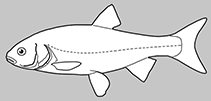
Raios dorsais moles (total) : 11; Raios anais moles: 11. Diagnosed from congeners in Turkey and adjacent waters by the combination of the following non-unique characters: presence of a spot on the scale pocket of each scale, covered by the preceding scale and appearing as a greyish spot at the posterior tip of the preceding scales; no or only few melanophores along the posterior margin of each flank scale; no black bar behind the opercle; most flank scales with a somewhat undulating outer margin; head length 27.8–-31.1 % SL), approximately 1.2-1.3 times body depth, head shape not sexually dimorphic; mouth terminal, without or with a very slightly distinct chin, its corner almost reaching the vertical through the anterior margin of the eye; length of mouth gape approximately equal to its width; upper jaw slightly projecting beyond lower jaw; upper lip thin, its anterior width approximately 1.3-1.5 times the width at the corner of the mouth; dorsal body profile behind head straight or very slightly convex, ventral profile slightly more convex than dorsal profile; anal fin not fleshy; caudal fin deeply forked (length of middle rays 59-68 % of length of lower lobe), lobes slightly pointed; lateral line with 38-42 + 1-2 scales; and anal and pelvic fins without orange pigments on rays in life (Ref. 93268).
Body shape (shape guide): fusiform / normal.
Occurs in swift and warm flowing water, with bottom comprising of cobbles and pebbles. Lives in association with Capoeta turani, Oxynoemacheilus seyhanensis and Alburnus sp.
Ciclo de vida e comportamento de acasalamento
Maturidade | Reprodução | Desova | Ovos | Fecundidade | Larvas
Turan, D., M. Kottelat and E. Doğan, 2013. Two new species of Squalius, S. adanaensis and S. seyhanensis (Teleostei: Cyprinidae), from the Seyhan River in Turkey. Zootaxa 3637(3):308-324. (Ref. 93268)
Categoria na Lista Vermelha da IUCN (Ref. 130435: Version 2025-2 (Global))
Ameaça para o homem
Harmless
Utilização humana
Ferramentas
Relatórios especiais
Descarregue XML
Fontes da internet
Estimativas baseadas em modelos
Índice de diversidade filogenética (Ref.
82804): PD
50 = 0.5000 [Uniqueness, from 0.5 = low to 2.0 = high].
Bayesian length-weight: a=0.00794 (0.00402 - 0.01570), b=3.13 (2.97 - 3.29), in cm total length, based on LWR estimates for this Genus-body shape (Ref.
93245).
Nível Trófico (Ref.
69278): 3.3 ±0.4 se; based on size and trophs of closest relatives
Resiliência (Ref.
120179): Médio, tempo mínimo de duplicação da população 1,4 - 4,4 anos (Preliminary K or Fecundity.).
Vulnerabilidade da pesca (Ref.
59153): Low vulnerability (12 of 100).
🛈