Classificazione / Nomi
Nomi Comuni | Sinonimi | Catalog of Fishes(Genere, Specie) | ITIS | CoL | WoRMS | Cloffa
>
Cyprinodontiformes (Rivulines, killifishes and live bearers) >
Rivulidae (Rivulines) > Cynolebiinae
Etymology: Spectrolebias: Latin, spectrum = imagen of a thing, apparition + Greek, lebias, ou = a kind of small fish (Ref. 45335); brousseaui: Named for Roger D. Brousseau, the person who discovered the species.
Eponymy: Dr Roger D Brousseau is a Californian aquarist and killifish hobbyist. [...] (Ref. 128868), visit book page.
Ambiente: milieu / zona climatica / distribuzione batimetrica / gamma di distribuzione
Ecologia
; acqua dolce pelagico; distribuzione batimetrica 0 - 1 m (Ref. 93219). Tropical
South America: Bolivia.
Dimensione / Peso / Età
Maturità: Lm ? range ? - ? cm
Max length : 3.2 cm SL maschio/sesso non determinato; (Ref. 93219); 3.5 cm SL (female)
Breve descrizione
Chiavi di identificazione | Morfologia | Morfometria
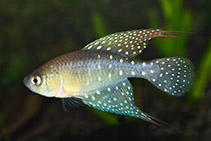
This species differs from its congeners by having a unique color pattern of males: anterior third of body light brown, posterior two-thirds of body dark blue, almost black dorsal region, with rows of bright blue spots, relatively large size, with about half the diameter of the pupil. It differs from all its congeners, except S. filamentosus, by having pelvic-fin bases separated by an interspaced (vs. pelvic-fin bases in contact), tip of dorsal and anal fins in males with long filamentous rays (vs. absence of filaments, or presents only on dorsal fin in S. semiocellatus and S. inaequipinnatus, or presents only on anal fin in S. chacoensis), and presence (vs. absence) of contact organs on scales of flank in males (Ref. 93219).
Body shape (shape guide): fusiform / normal; Cross section: compressed.
The locality where the species occurs lies at the plateau area (316 m.a.s.l.), just southwest of Llanos de Mojos, which occupy much of the río Mamoré basin. Water temperature at the surface of the pool was 31ºC, at 1 meter depth was 22ºC, and at the marginal area of the pool, at 15 cm depth, was 35ºC. Only small specimens of Trigonectes sp. were collected syntopically in marginal areas, while specimens of Simpsonichthys brousseaui were collected in the deepest areas, at about 1 m deep. The pool has dark water, pH 6.8 and water hardness 80 ppm (Ref. 93219).
Ciclo vitale e comportamento di accoppiamento
Maturità | Riproduzione | Deposizione | Uova | Fecondità | Larve
Nielsen, D.T.B., 2013. Spectrolebias brousseaui (Cyprinodontiformes: Rivulidae: Cynolebiatinae), a new annual fish from the upper río Mamoré basin, Bolivia. Neotrop. Ichthyol. 11(1):81-84. (Ref. 93219)
Stato della Lista Rossa IUCN (Ref. 130435: Version 2025-2 (Global))
Minaccia per l'uomo
Harmless
Usi umani
Pesca: di nessun interesse
Strumenti
Rapporti speciali
Scarica XML
Fonti Internet
Stime basate su modelli
Indice di diversità filogenetica (Fonte Biblio.
82804): PD
50 = 0.5020 [Uniqueness, from 0.5 = low to 2.0 = high].
Bayesian length-weight: a=0.01122 (0.00514 - 0.02450), b=3.04 (2.87 - 3.21), in cm total length, based on all LWR estimates for this body shape (Ref.
93245).
Livello trofico (Fonte Biblio.
69278): 3.1 ±0.4 se; based on size and trophs of closest relatives
Resilienza (Fonte Biblio.
120179): Alto, tempo minimo di raddoppiamento della popolazione meno di 15 mesi (Preliminary K or Fecundity.).
Vulnerabilità della pesca (Ref.
59153): Low vulnerability (10 of 100).
🛈