Classificazione / Nomi
Nomi Comuni | Sinonimi | Catalog of Fishes(Genere, Specie) | ITIS | CoL | WoRMS | Cloffa
>
Gymnotiformes (Knifefishes) >
Sternopygidae (Glass knifefishes) > Eigenmanninae
Etymology: Archolaemus: Greek, archo = anus + Greek, laimos = throat (Ref. 45335); ferreirai: Named for Efrem Ferreira of the Instituto Nacional de Pesquisas da Amazônia, one of the collectors of the type series, in recognition of his many contributions to the understanding of the Amazonian fish fauna.
Eponymy: Dr Efrem Jorge Gondim Ferreira (d: 1954) is a Brazilian ichthyologist, who is a Senior Researcher III at Instituto Nacional de Pesquisas da Amazônia, Manaus, and Professor of the Postgraduate Programme in Fresh Water Biology and Inland Fisheries. [...] (Ref. 128868), visit book page.
Ambiente: milieu / zona climatica / distribuzione batimetrica / gamma di distribuzione
Ecologia
; acqua dolce benthopelagico. Tropical
South America: Rio Mucajaí and Rio Uraricoera in the north-eastern portions of the Amazon basin, Brazil.
Dimensione / Peso / Età
Maturità: Lm ? range ? - ? cm
Max length : 34.2 cm TL maschio/sesso non determinato; (Ref. 93148)
Breve descrizione
Chiavi di identificazione | Morfologia | Morfometria
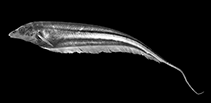
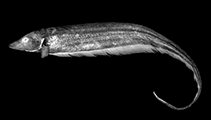
Raggi anali molli: 190 - 222. Distinguished from other congeners by having the following combinations of characters: length of the gape with the rictus falling short of the vertical through the posterior naris; the length of the coronomeckelian bone 50% or more the length of Meckel’s cartilage; the length of the posterior ceratohyal approximately the same length as the ventral hypohyal; 10-14 scales above the lateral line at the midbody; the form of the premaxilla with the anteroposterior length greater than the transverse width; the distribution of the teeth on the dentary restricted to anterior one-half or slightly more of the dorsal margin; five or six teeth arranged in single row on the internal surface of the endopterygoid; presence of a narrow dark stripe along the lateral line and a broad band of dusky to dark pigmentation overlying the basal pterygiophores of the anal fin; 18-21 pectoral-fin rays; 190-222 anal-fin rays (Ref. 93148).
Body shape (shape guide): elongated.
The type locality, Rio Mucajaí, is characterized by rapid flowing water and a 20 m high waterfall. The species was encountered above these falls in an area with many rapids and no still backwaters (Ref. 93148).
Ciclo vitale e comportamento di accoppiamento
Maturità | Riproduzione | Deposizione | Uova | Fecondità | Larve
Vari, R.P., C.D. de Santana and W.B. Wosiacki, 2012. South American electric knifefishes of the genus Archolaemus (Ostariophysi, Gymnotiformes): undetected diversity in a clade of rheophiles. Zoological Journal of the Linnaean Society 165:670-699. (Ref. 93148)
Stato della Lista Rossa IUCN (Ref. 130435: Version 2025-2 (Global))
Minaccia per l'uomo
Harmless
Usi umani
Pesca: di nessun interesse
Strumenti
Rapporti speciali
Scarica XML
Fonti Internet
Stime basate su modelli
Indice di diversità filogenetica (Fonte Biblio.
82804): PD
50 = 0.5156 [Uniqueness, from 0.5 = low to 2.0 = high].
Bayesian length-weight: a=0.00355 (0.00161 - 0.00782), b=2.97 (2.78 - 3.16), in cm total length, based on LWR estimates for this (Sub)family-body shape (Ref.
93245).
Livello trofico (Fonte Biblio.
69278): 3.1 ±0.3 se; based on size and trophs of closest relatives
Vulnerabilità della pesca (Ref.
59153): Low vulnerability (24 of 100).
🛈