Klassificering / Namn
Populärnamn | synonymer | Catalog of Fishes(Släkte, Arter) | ITIS | CoL | WoRMS | Cloffa
>
Siluriformes (Catfishes) >
Sisoridae (Sisorid catfishes) > Sisorinae
Etymology: Glyptothorax: Greek, glyptes = carver + Greek, thorax = breast (Ref. 45335); igniculus: From the Latin noun igniculus, meaning a little flame, in allusion to the lanceolate, flame-shaped central depression in the thoracic adhesive apparatus that is nearly completely enclosed by skin ridges caudally.
Miljö: miljö / Klimatzon / djupintervall / distributionsområde
Ekologi
; sötvatten bottenlevande. Tropical
Asia: Myittha River, a tributary of the Chindwin River in Myanmar.
Storlek / Vikt / Ålder
Könsmognad: Lm ? range ? - ? cm
Max length : 7.1 cm SL hane/ej könsbestämd; (Ref. 93787)
Kort beskrivning
Bestämningsnycklar | Morfologi | Morfometri
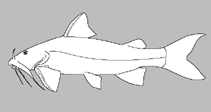
Mjukstrålar i ryggfenan (totalt) : 7; Mjukstrålar i analfenan: 12 - 13; Ryggkotor: 35 - 36. Can be diagnosed from other species of Glyptothorax in the Irrawaddy River drainage by its thoracic adhesive apparatus, in which the central depression is almost completely enclosed posteriorly by the skin ridges that make up the apparatus, instead of open caudally or, in G. burmanicus, completely closed. Further differs from G. burmanicus in having a larger eye (diameter 10.4-12.7% HL vs. 6.3-10.0), a longer dorsal-fin spine (16.9-21.6% SL vs. 11.9-14.7), and shorter prepectoral (17.1-21.7% SL vs. 22.3-25.4) and prepelvic lengths (47.0-51.3% SL vs. 52.8-59.4). Distinguished from other congeners by having the following combination of diagnostic characters: dorsal-fin spine length 16.9-21.6% SL; dorsal-to-adipose distance 19.8-24.6% SL; body depth at anus 15.2-16.4% SL; caudal peduncle depth 8.2-9.7% SL; total vertebrae 35-36; head width 20.3-21.8% SL; rounded tubercles on the dorsal surface of the head; almost uniform body; nasal barbel length 30.1-35.5% HL; lack ridges of the thoracic adhesive apparatus extending onto the gular region; head length 25.3-28.2% SL; predorsal distance 35.6-37.4% SL; postadipose distance 18.8-20.8% SL; and adipose-fin base length 13.9-15.8% SL; the depressed central in the thoracic adhesive apparatus lanceolate; with a single, non-diverging series of striae running along its edges; anal-fin base length 14.1-17.8% SL; pectoral-fin length 21.2-26.1% SL; lacking plicae on the ventral surfaces of the first pectoral- and pelvic-fin elements; and lacking both a distinct pale midlateral stripe on the body and distinct dark submarginal stripe along each lobe of the caudal fin (Ref. 93787).
Body shape (shape guide): elongated.
Found in a wide (ca. 200 m), turbid river with moderate current and a substrate composed of clay (Ref. 93787).
Livscykel och parningsbeteende
Könsmognad | Reproduktion | Lek | Ägg | Fekunditet | Larver
Ng, H.H. and S.O. Kullander, 2013. Glyptothorax igniculus, a new species of sisorid catfish (Teleostei: Siluriformes) from Myanmar. Zootaxa 3681(5):552-562. (Ref. 93787)
Status på IUCN:s rödlista (Ref. 130435: Version 2025-2 (Global))
Hot mot människor
Harmless
Mänskliga användningsområden
Fiskeri: saknar intresse
Verktyg
Särskilda rapporter
Ladda ner XML
Internet-källor
Uppskattningar baserade på modeller
Index för fylogenetisk mångfald (Ref.
82804): PD
50 = 0.5000 [Uniqueness, from 0.5 = low to 2.0 = high].
Bayesian length-weight: a=0.00794 (0.00365 - 0.01726), b=3.02 (2.85 - 3.19), in cm total length, based on LWR estimates for this Genus-body shape (Ref.
93245).
Trofisk nivå (Ref.
69278): 3.2 ±0.4 se; based on size and trophs of closest relatives
Resiliens (Ref.
120179): Mellan, lägsta populationsfördubblingstid 1,4-4,4 år (Preliminary K or Fecundity.).
Sårbarhet i fisket (Ref.
59153): Low vulnerability (10 of 100).
🛈