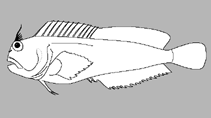
Classificazione / Nomi
Nomi Comuni | Sinonimi | Catalog of Fishes(Genere, Specie) | ITIS | CoL | WoRMS | Cloffa
>
Blenniiformes (Blennies) >
Blenniidae (Combtooth blennies) > Salariinae
Etymology: Medusablennius: Taken from Medusa, one of the three Gorgons, whose head with snakes turned him looked upon it into a stone + Greek, blennios = mucus (Ref. 45335); chani: Named for William L. Chan, the person who first noticed the distinctness of the species.
Eponymy: In Greek mythology, Medusa was a Gorgon whose hair was made up of living snakes. The name is used fancifully for taxa with numerous filaments or barbels. William L Chan was the first to notice the distinctness of this species (in a note in the jar containing the type specimens collected in 1955) which Springer examined (1963) at Stanford University’s George Vanderbilt Foundation collection. [...] (Ref. 128868), visit book page.
Ambiente: milieu / zona climatica / distribuzione batimetrica / gamma di distribuzione
Ecologia
marino pelagic-neritic. Tropical
Eastern Central Pacific: Tuamotu Archipelago.
Dimensione / Peso / Età
Maturità: Lm ? range ? - ? cm
Max length : 1.5 cm SL maschio/sesso non determinato; (Ref. 86957)
Breve descrizione
Chiavi di identificazione | Morfologia | Morfometria
Spine dorsali (totale) : 11 - 12; Raggi dorsali molli (totale) : 17 - 18; Spine anali: 2; Raggi anali molli: 19. This species is distinguished by the following characters: no scales; 2 bones in the circumorbital ring, cirri on head numerous and complex; dorsal fin with more rays than spines; interopercle not extending posteriorly beyond its connection with the epihyal; ascending wing of the parasphenoid reaching the frontal; free dorsal margin to the upper lip; teeth restricted to a single series in each jaw, absent in vomer and palatines (Ref. 86957).
Body shape (shape guide): elongated; Cross section: oval.
Oviparous. Eggs are demersal and adhesive (Ref. 205), and are attached to the substrate via a filamentous, adhesive pad or pedestal (Ref. 94114). Larvae are planktonic, often found in shallow, coastal waters (Ref. 94114).
Ciclo vitale e comportamento di accoppiamento
Maturità | Riproduzione | Deposizione | Uova | Fecondità | Larve
Springer, V.G., 1966. Medusablennius chani, a new genus and species of blennioid fish from the Tuamotu Archipelago: its implication on blennioid classification. Copeia 1966(1):56-60. (Ref. 86957)
Stato della Lista Rossa IUCN (Ref. 130435: Version 2025-2 (Global))
Minaccia per l'uomo
Harmless
Usi umani
Strumenti
Rapporti speciali
Scarica XML
Fonti Internet
Stime basate su modelli
Indice di diversità filogenetica (Fonte Biblio.
82804): PD
50 = 1.0000 [Uniqueness, from 0.5 = low to 2.0 = high].
Bayesian length-weight: a=0.00776 (0.00354 - 0.01702), b=3.00 (2.81 - 3.19), in cm total length, based on LWR estimates for this (Sub)family-body shape (Ref.
93245).
Resilienza (Fonte Biblio.
120179): Alto, tempo minimo di raddoppiamento della popolazione meno di 15 mesi (Preliminary K or Fecundity.).
Vulnerabilità della pesca (Ref.
59153): Low vulnerability (10 of 100).
🛈