>
Perciformes/Scorpaenoidei (Scorpionfishes) >
Aploactinidae (Velvetfishes)
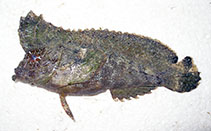
Etymology: Pseudopataecus: Name from Greek, 'pseudo' meaning false; referring to its false likeness to the pataecid genus Pataecus; carnatobarbatus: Name from Latin 'carnatio' meaning fleshy and 'barbatus' for bearded; referring to the goatee-like beard of fleshy cirri present around the lower chin.
Ambiente: milieu / zona climatica / distribuzione batimetrica / gamma di distribuzione
Ecologia
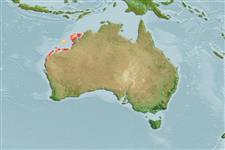
marino associati a barriera corallina; distribuzione batimetrica 0 - 13 m (Ref. 89851). Tropical; 15°S - 24°S, 114°E - 125°E (Ref. 89851)
Eastern Indian Ocean: Western Australia.
Dimensione / Peso / Età
Maturità: Lm ? range ? - ? cm
Max length : 9.7 cm SL maschio/sesso non determinato; (Ref. 89851)
Breve descrizione
Chiavi di identificazione | Morfologia | Morfometria
Spine dorsali (totale) : 13 - 14; Raggi dorsali molli (totale) : 13 - 14; Spine anali: 1; Raggi anali molli: 9 - 11; Vertebre: 31 - 32. This species is distinguished by the following characters: D XIII-XIV,13i-14i; A I,9i-11i; pectoral-fin rays 11-12; pelvic-fin rays I,3; gill rakers on first gill arch 0-4 + 5-8, 6-11 total; lateral-line tubes 13-17; vertebrae, including urostyle, 31-32; dorsal-, anal-, pectoral-, first two pelvic- and most caudal-fin rays are branched near their tips, except in juveniles; last soft dorsal-fin ray joined for most of its length by a membrane to the proximal third of upper caudal-fin ray; spinous dorsal fin strongly notched, between 3rd and 8th spines; relatively robust pelvic fins, with third or innermost ray subequal to second ray; smooth anterior face of lower lip, a single row of small unbranched cirri along its upper margin; forehead with a narrow quadrangular pit, bounded by frontal, supraorbital, ocular and preocular ridges (Ref. 89851).
Body shape (shape guide): fusiform / normal; Cross section: compressed.
Collected and observed usually in broad shallow pools within degenerating low-relief reef, with dead coral heads, overhangs and crevices, with scattered shell and coral rubble, often among thick stands of brown macroalgae, Padina and Sargassum species (Ref. 89851).
Ciclo vitale e comportamento di accoppiamento
Maturità | Riproduzione | Deposizione | Uova | Fecondità | Larve
Johnson, J.W., 2012. Pseudopataecus carnatobarbatus, a new species of velvetfish (Teleostei: Scorpaeniformes: Aploactinidae) from the Kimberley coast of Western Australia. Zootaxa 3245:54-62. (Ref. 89851)
Stato della Lista Rossa IUCN (Ref. 130435: Version 2025-2 (Global))
Minaccia per l'uomo
Harmless
Usi umani
Strumenti
Rapporti speciali
Scarica XML
Fonti Internet
Stime basate su modelli
Temperatura preferita (Fonte Biblio.
123201): 26.7 - 28.3, mean 28.1 °C (based on 52 cells).
Indice di diversità filogenetica (Fonte Biblio.
82804): PD
50 = 0.7500 [Uniqueness, from 0.5 = low to 2.0 = high].
Bayesian length-weight: a=0.01122 (0.00514 - 0.02450), b=3.04 (2.87 - 3.21), in cm total length, based on all LWR estimates for this body shape (Ref.
93245).
Livello trofico (Fonte Biblio.
69278): 3.5 ±0.4 se; based on size and trophs of closest relatives
Vulnerabilità della pesca (Ref.
59153): Low vulnerability (10 of 100).
🛈