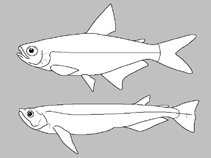
Classificatie / Namen
Lokale namen | Synoniemen | Catalog of Fishes(Genus, Soort(en)) | ITIS | CoL | WoRMS | Cloffa
>
Characiformes (Characins) >
Characidae (Characins; tetras) > Tetragonopterinae
Etymology: Tetragonopterus: Name from Greek words: 'Tetra' meaning four; 'gonia' meaning angle; 'pteron' for fin; referring to the evident tetragonal shape of the body (Ref. 124043); araguaiensis: The specific name araguaiensis is in reference to the major drainage of the type-locality, the Rio Araguaia, a large tributary of the Amazon basin, central Brazil.
Milieu: milieu / Klimaatzone / Diepte / verspreidingsgebied
Ecologie
; zoet water pelagisch. Tropical
South America: middle portion of the Rio Araguaia in Brazil.
Grootte / Gewicht / Leeftijd
Maturiteit: Lm ? range ? - ? cm
Max length : 6.3 cm SL mannelijk / geslacht onbekend; (Ref. 93280)
Dorsale zachte stralen (totaal) : 9; Anale zachte stralen: 37 - 40. This species is distinguished from its congeners except Tetragonopterus anostomus by the number of gill rakers on the upper and lower limbs of the first gill arch, 10-12 and 18-20, respectively (vs. 8-10 and 12-14); differs from T. anostomus by the terminal mouth (vs. subsuperior); differs from T. anostomus, T. kuluene, T. juruena, T. denticulatus in the number of principal teeth in the dentary 4 (vs. 5-6) and also by having larger and more robust teeth (vs. thinner and sharper teeth); differs from T. argenteus by the number of predorsal scales 7-9 (vs. 111-17); differs from T. carvalhoi by having a spot on the caudal peduncle that is round (vs. lozenge-shaped spot); differs from T. ommatus by the teeth on the maxilla 0-2 (vs. 7-8) and having a centered mark on the caudal peduncle (vs. limited to the posterior portion of the caudal peduncle); differs from T. rarus, T. georgiae by the scale rows between lateral line and pelvic-fin origin 3.5 (vs. 4.5-5.5); differs from T. rarus by the lack of dark stripes on the lateral surface of the body (vs. the presence of such stripes) (Ref. 124043).
Body shape (shape guide): short and / or deep; Cross section: compressed.
Levenscyclus en paargedrag
Maturiteit | Voortplanting | Paaien | Eieren | Fecunditeit | Larven
Silva, G.S.C., B.F. Melo, C. Oliveira and R.C. Benine, 2016. Revision of the South American genus Tetragonopterus Cuvier, 1816 (Teleostei: Characidae) with description of four new species. Zootaxa 4200(1):1-46. (Ref. 124043)
Status op de Rode Lijst van het IUCN (Ref. 130435: Version 2025-2 (Global))
Gevaar voor de mens
Harmless
Gebruik door de mens
Tools
Speciale rapporten
Download XML
Internetbronnen
Schattingen op basis van modellen
Fylogenetische diversiteitsindex (Ref.
82804): PD
50 = 0.5000 [Uniqueness, from 0.5 = low to 2.0 = high].
Bayesian length-weight: a=0.02570 (0.01066 - 0.06197), b=2.98 (2.79 - 3.17), in cm total length, based on LWR estimates for this Genus-body shape (Ref.
93245).
Trofisch niveau (Ref.
69278): 3.4 ±0.4 se; based on size and trophs of closest relatives
Kwetsbaarheid van de visserij (Ref.
59153): Low vulnerability (10 of 100).
🛈