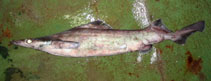
Ελασμοβράγχιοι (καρχαρίες και σαλάχια) (sharks and rays) >
Squaliformes (Sleeper and dogfish sharks) >
Centrophoridae (Gulper sharks)
Etymology: Deania: -ia (Gr.), belonging to: American ichthyologist Bashford Dean (1867-1928), American Museum of Natural History, for his research on selachian fishes (See ETYFish); calceus: Latin for shoe, from the Portuguese vernacular sapata for this and other squaliform sharks, e.g., Centroselachus crepidater, Somniosidae; also known as sapata branca, white shoe, allusion not explained, perhaps referring to how its gray-white body with a long snout resembles a velvet slipper [often misspelled calcea] (See ETYFish).
Eponymy: Dr Bashford Dean (1857–1928) was an American zoologist, ichthyologist and acknowledged expert on mediaeval armour. [...] (Ref. 128868), visit book page.
More on author: Lowe.
Περιβάλλον: περιβάλλον / κλιματική ζώνη / εύρος βάθους / εύρος διανομής
Οικολογία
Θαλασσινό(ά) βαθύβιο(ς); εύρος βάθους 60 - 1490 m (Ref. 26346), usually 400 - 1400 m (Ref. 10717). Deep-water; 70°N - 56°S, 180°W - 180°E
East Atlantic: Iceland to South Africa. Indian Ocean: South Africa, southern Madagascar, southern Australia. Pacific Ocean: Indonesia, Japan, Taiwan, southeast Australia, New Zealand, and Peru to Chile.
Μήκος κατά την πρώτη ωρίμανση / Μέγεθος / Βάρος / Ηλικία
Γεννητική Ωρίμανση: Lm 97.8, range 70 - 111 cm
Max length : 127 cm TL αρσενικό/απροσδιόριστο; (Ref. 122636); μεγ. δημοσιευμένο βάρος: 8.7 kg (Ref. 122636)
Ραχιαίες άκανθες (συνολικά) : 2; Εδρικές άκανθες: 0. A longnose dogfish with a long, 1st dorsal fin and no subcaudal keel (Ref. 5578). Grey-brownish in color (Ref. 6577).
Body shape (shape guide): elongated.
Found on the outer continental and insular shelves and upper slopes (Ref. 247). Usually on or near the bottom but sometimes found well above it (Ref. 5578). Apparently in large schools (Ref. 5578). Feeds on pelagic bony fish, squid, octopus and shrimp (Ref. 5578). Ovoviviparous (Ref. 50449). Caught very rarely by demersal longline fisheries operating in deepwater of Indonesia. Utilized for its meat, fins (low value) and liver oil (very high value) (Ref. 58048).
Ovoviviparous, embryos feed solely on yolk (Ref. 50449). Young possibly number 6 to 12 in a litter, as these were the number of fertilized eggs found in the uteri of some specimens (Ref. 247). Size at birth 29 to 34 cm (Ref. 26346). Distinct pairing with embrace (Ref. 205).
Compagno, L.J.V., 1984. FAO Species Catalogue. Vol. 4. Sharks of the world. An annotated and illustrated catalogue of shark species known to date. Part 1 - Hexanchiformes to Lamniformes. FAO Fish. Synop. 125(4/1):1-249. Rome, FAO. (Ref. 247)
Κατάσταση Κόκκινου Καταλόγου IUCN (Ref. 130435: Version 2025-2 (Global))
Απειλή για τον άνθρωπο
Harmless
Ανθρώπινες χρήσεις
αλιεία: περιορισμένης εμπορικότητας
Εργαλεία
Ειδικές εκθέσεις
Λήψη XML
Διαδικτυακές πηγές
Εκτιμήσεις βάσει μοντέλων
Προτιμώμενη θερμοκρασία (Αναφ.
123201): 0.3 - 9.6, mean 5.1 °C (based on 991 cells).
Δείκτης φυλογενετικής ποικιλότητας (Αναφ.
82804): PD
50 = 0.5625 [Uniqueness, from 0.5 = low to 2.0 = high].
Bayesian length-weight: a=0.00186 (0.00120 - 0.00289), b=3.16 (3.03 - 3.29), in cm total length, based on LWR estimates for this species & (Sub)family-body (Ref.
93245).
Τροφικό Επίπεδο (Αναφ.
69278): 4.3 ±0.4 se; based on diet studies.
Generation time: 14.3 ( na - na) years. Estimated as median ln(3)/K based on 2
growth studies.
Ελαστικότητα (Αναφ.
120179): Πολύ χαμηλό, ελάχιστος χρόνος για διπλασιασμό πληθυσμού > 14 έτη (K=0.077-0.135; Fec=6-12; tm=25).
Ευπάθεια στην αλιεία (Ref.
59153): High to very high vulnerability (66 of 100).
🛈
Ευπάθεια στο κλίμα (Ref.
125649): High vulnerability (62 of 100).
🛈
Θρεπτικά συστατικά (Ref.
124155): Calcium = 6.67 [1.36, 34.84] mg/100g; Iron = 0.319 [0.075, 1.026] mg/100g; Protein = 20.9 [17.9, 23.1] %; Omega3 = 0.303 [0.112, 0.975] g/100g; Selenium = 17.8 [5.4, 52.0] μg/100g; VitaminA = 9.83 [2.22, 44.15] μg/100g; Zinc = 0.249 [0.120, 0.471] mg/100g (wet weight); based on
nutrient studies.