Elasmobranquios (tiburones y rayas) (sharks and rays) >
Carcharhiniformes (Ground sharks) >
Pentanchidae (Deepwater catsharks)
Etymology: Apristurus: a-, Latin privative, i.e., without; pristis, from pristes (Gr.), sawyer (but here meaning saw); oura (Gr.), tail, referring to absence of saw-toothed crest of enlarged dermal denticles along upper edge of caudal fin as found in the closely related Pristiurus (=Galeus) (See ETYFish); garricki: In honor of J.A.F. (Jack) Garrick (1928-2018), “pioneer” New Zealand shark taxonomist and biologist, the first to recognize this genus from New Zealand waters; he also “generously” shared his notes on this species with the authors (See ETYFish).
Eponymy: Dr John Andrew Frank (Jack) Garrick (1928–2018) was a New Zealand ichthyologist with a specialization in elasmobranchs. [...] (Ref. 128868), visit book page.
Entorno: milieu / zona climática / rango de profundidad / gama de distribución
Ecología
marino batidemersal. Deep-water
Pacific Ocean: New Zealand (Ref. 93572).
Tamaño / Peso / Edad
Madurez: Lm ? range ? - ? cm
Max length : 67.5 cm SL macho / no sexado; (Ref. 93572); 73.5 cm (female)
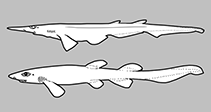
A species of Apristurus with the following characters in combination: very long snout, pre-outer nostril length greater than interorbital width; short P1�P2 distance, tip of pectoral fin reaching to midway of P1�P2 space; small first dorsal fin and its origin always behind pelvic fin axil; long base of anal fin 13.7�-17.7% of TL; vertebral counts of monospondylous 34-�37 and those of precaudal diplospondylous 32�-39; total counts of precaudal vertebrae 66-73; intestinal spiral valves 10�13; tooth rows 37-�50 on upper, 38-�49 on lower jaws (Ref. 93572).
Body shape (shape guide): elongated.
Ciclo vital y comportamiento de apareamiento
Madurez | Reproducción | Puesta | Huevos | Fecundidad | Larva
Sato, K., A.L. Stewart and K. Nakaya, 2013. Apristurus garricki sp. nov., a new deep-water catshark from the northern New Zealand waters (Carcharhiniformes: Scyliorhinidae). Marine Biology Research 9(8):758-767. (Ref. 93572)
Situación en la Lista Roja de la UICN (Ref. 130435: Version 2025-2 (Global))
Amenaza para el ser humano
Harmless
Usos humanos
Herramientas
Informes especiales
Descargar XML
Fuentes de Internet
Estimaciones basadas en modelos
Índice de diversidad filogenética (Referencia
82804): PD
50 = 0.5000 [Uniqueness, from 0.5 = low to 2.0 = high].
Bayesian length-weight: a=0.00347 (0.00172 - 0.00698), b=3.08 (2.90 - 3.26), in cm total length, based on LWR estimates for this (Sub)family-body shape (Ref.
93245).
Nivel trófico (Referencia
69278): 4.0 ±0.6 se; based on size and trophs of closest relatives
Resiliencia (Referencia
120179): Medio, población duplicada en un tiempo mínimo de 1.4-4.4 años (Preliminary K or Fecundity.).
Vulnerabilidad pesquera (Ref.
59153): Moderate to high vulnerability (47 of 100).
🛈