Ταξινόμηση / Ονόματα
Κοινά ονόματα | Συνώνυμα | Catalog of Fishes(Γένος, Είδη) | ITIS | CoL | WoRMS | Cloffa
>
Characiformes (Characins) >
Lebiasinidae (Pencilfishes) > Pyrrhulininae
Etymology: Pyrrhulina: Greek, pyrrhos = red, with the colour of the fire (Ref. 45335); marilynae: The specific epithet is in honor to Marilyn Weitzman, for her assistance to both authors since the beginning of their enterprise in studying fishes of the family Lebiasinidae. A noun (Ref. 93568).
Eponymy: Mrs Marilyn Jean Weitzman née Sohner (d: 1926) is a Research Associate at the Smithsonian, where she has devoted her career to the study of fishes of the Lebiasinidae and Characidae families. [...] (Ref. 128868), visit book page.
Περιβάλλον: περιβάλλον / κλιματική ζώνη / εύρος βάθους / εύρος διανομής
Οικολογία
; Γλυκού νερού Πελαγικό(ά). Tropical; 11°S - 13°S, 55°W - 57°W
South America: Brazil. Pyrrhulina marilynae is known from the headwaters of the rio Tapajós and rio Xingu in the Brazilian Shield (Ref. 93568).
Μέγεθος / Βάρος / Ηλικία
Γεννητική Ωρίμανση: Lm ? range ? - ? cm
Max length : 3.0 cm SL αρσενικό/απροσδιόριστο; (Ref. 93568)
Σύντομη περιγραφή
Κλείδες προσδιορισμού | Μορφολογία | Μορφομετρία
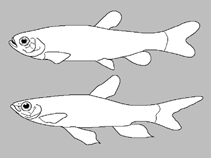
Pyrrhulina marilynae differs from all congeners (except Pyrrhulina zigzag) by presenting a conspicuous, dark primary stripe extending from tip of snout to middle caudal-fin rays, with a zigzag pattern along most body length (vs. primary stripe straight and narrow, mostly restricted to the head or not extending posterior to vertical through anal fin origin). Pyrrhulina marilynae differs from P. zigzag by the presence of a distinct, clear zigzag area lying between the primary stripe and the strongly pigmented dorsum; the lack of a hiatus on the primary stripe; and the absence of elongate dorsal-, anal- and caudal-fin rays in males (vs. clear zigzag area absent, and dorsum poorly pigmented; presence of a hiatus on the primary stripe at approximately fifth scale of fourth longitudinal series; rays of dorsal, anal and caudal-fin upper lobe distinctly elongate in males). The new species further differs from all congeners (except P. australis) by presenting nine principal rays on caudal-fin dorsal lobe, and 18 or less precaudal vertebrae (vs. 10 principal rays on caudal-fin dorsal lobe and 19 or more precaudal vertebrae). It can be further distinguished from P. australis by the absence of the posthcleithrum 2 (vs. postcleithrum 2 present). Pyrrhulina marilynae differs from all congeners (except Pyrrhulina zigzag) by presenting a conspicuous, dark primary stripe extending from tip of snout to middle caudal-fin rays, with a zigzag pattern along most body length (vs. primary stripe straight and narrow, mostly restricted to the head or not extending posterior to vertical through anal fin origin). Pyrrhulina marilynae differs from P. zigzag by the presence of a distinct, clear zigzag area lying between the primary stripe and the strongly pigmented dorsum; the lack of a hiatus on the primary stripe; and the absence of elongate dorsal-, anal- and caudal-fin rays in males (vs. clear zigzag area absent, and dorsum poorly pigmented; presence of a hiatus on the primary stripe at approximately fifth scale of fourth longitudinal series; rays of dorsal, anal and caudal-fin upper lobe distinctly elongate in males). The new species further differs from all congeners (except P. australis) by presenting nine principal rays on caudal-fin dorsal lobe, and 18 or less precaudal vertebrae (vs. 10 principal rays on caudal-fin dorsal lobe and 19 or more precaudal vertebrae). It can be further distinguished from P. australis by the absence of the posthcleithrum 2 (vs. postcleithrum 2 present) (Ref. 93568).
Body shape (shape guide): elongated; Cross section: oval.
Κύκλος ζωής και συμπεριφορά ζευγαρώματος
Γεννητική Ωρίμανση | Αναπαραγωγή | Γεννοβολία | Αβγά | Γονιμότητα | Προνύμφες
Netto-Ferreira, A.L. and M.M.F. Marinho, 2013. New species of Pyrrhulina (Ostariophysi: Characiformes: Lebiasinidae) from the Brazilian Shield, with comments on a putative monophyletic group of species in the genus. Zootaxa 3664(3):369-376. (Ref. 93568)
Κατάσταση Κόκκινου Καταλόγου IUCN (Ref. 130435: Version 2025-2 (Global))
Απειλή για τον άνθρωπο
Harmless
Ανθρώπινες χρήσεις
αλιεία: με δυνητικό ενδιαφέρον
Εργαλεία
Ειδικές εκθέσεις
Λήψη XML
Διαδικτυακές πηγές
Εκτιμήσεις βάσει μοντέλων
Δείκτης φυλογενετικής ποικιλότητας (Αναφ.
82804): PD
50 = 0.5000 [Uniqueness, from 0.5 = low to 2.0 = high].
Bayesian length-weight: a=0.00646 (0.00280 - 0.01488), b=3.13 (2.93 - 3.33), in cm total length, based on LWR estimates for this (Sub)family-body shape (Ref.
93245).
Τροφικό Επίπεδο (Αναφ.
69278): 3.1 ±0.4 se; based on size and trophs of closest relatives
Ευπάθεια στην αλιεία (Ref.
59153): Low vulnerability (10 of 100).
🛈