Classificazione / Nomi
Nomi Comuni | Sinonimi | Catalog of Fishes(Genere, Specie) | ITIS | CoL | WoRMS | Cloffa
>
Eupercaria/misc (Various families in series Eupercaria) >
Labridae (Wrasses) > Cirrhilabrinae
Etymology: Pteragogus: Greek, pteron = wing, fin + Greek, ago = to drive (Ref. 45335); clarkae: Named for Dr. Eugenie Clark, not only for her collection of most of the type specimens, but also in recognition of her major contribution to the classification and biology of fishes (Ref. 93522).
Eponymy: Dr Eugenie Clark (1922–2015), sometimes known as ‘The Shark Lady’, was a Japanese-American ichthyologist. [...] (Ref. 128868), visit book page.
Ambiente: milieu / zona climatica / distribuzione batimetrica / gamma di distribuzione
Ecologia
marino associati a barriera corallina. Tropical
Western Indian Ocean: Red Sea, Egypt.
Dimensione / Peso / Età
Maturità: Lm ? range ? - ? cm
Max length : 6.5 cm SL maschio/sesso non determinato; (Ref. 93522)
Breve descrizione
Chiavi di identificazione | Morfologia | Morfometria
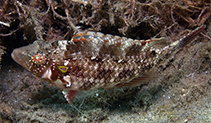
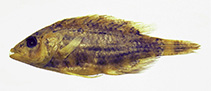
Spine dorsali (totale) : 11; Raggi dorsali molli (totale) : 9; Spine anali: 3; Raggi anali molli: 9; Vertebre: 24. This species is distinguished by the following characters: D XI,9; A III,9; pectoral rays 13-14 (usually 13); complete lateral line, angling sharply downward below soft portion of anal fin to straight peduncular part, 24 pored scales 24 (plus 2 on base of caudal fin, the last greatly enlarged); body moderately deep, depth 2.95-3.15 in SL; head length (HL) 2.6 in SL; head's dorsal profile straight; straight part of posterior margin of preopercle serrate, serrae varying from 14 on 34.5-mm paratype to 21 on the 64.5-mm paratype; dorsal spines progressively longer, last 1.95-2.2 in HL; caudal fin rounded and moderately long 3.0-3.25 in SL; first soft ray of pelvic fins not very long, 3.5-3.8 in SL. Colour in alcohol yellowish brown with dark brown blotches on lower side of body; small dark brown spots along anterior part of lateral line; scattered small dark brown spots on nape; dark brown dash or pair of small dark spots on side of snout before eye; only traces remain of opercular ocellus; posterior margin of preopercle and an adjacent band of opercle pale yellowish; dorsal fin pale yellowish with a dark brown spot on each of first two spinous membranes, the second spot usually smaller; an irregular black spot at rear base of dorsal fin (Ref. 93522).
Body shape (shape guide): short and / or deep; Cross section: compressed.
Ciclo vitale e comportamento di accoppiamento
Maturità | Riproduzione | Deposizione | Uova | Fecondità | Larve
Oviparous, distinct pairing during breeding (Ref. 205).
Randall, J.E., 2013. Seven new species of labrid fishes (Coris, Iniistius, Macropharyngodon, Novaculops, and Pteragogus) from the Western Indian Ocean. J. Ocean Sci. Found. 7:1-43. (Ref. 93522)
Stato della Lista Rossa IUCN (Ref. 130435: Version 2025-2 (Global))
Minaccia per l'uomo
Harmless
Usi umani
Strumenti
Rapporti speciali
Scarica XML
Fonti Internet
Stime basate su modelli
Indice di diversità filogenetica (Fonte Biblio.
82804): PD
50 = 0.5005 [Uniqueness, from 0.5 = low to 2.0 = high].
Bayesian length-weight: a=0.01995 (0.00906 - 0.04395), b=3.01 (2.83 - 3.19), in cm total length, based on all LWR estimates for this body shape (Ref.
93245).
Livello trofico (Fonte Biblio.
69278): 3.3 ±0.4 se; based on size and trophs of closest relatives
Resilienza (Fonte Biblio.
120179): Alto, tempo minimo di raddoppiamento della popolazione meno di 15 mesi (Preliminary K or Fecundity.).
Vulnerabilità della pesca (Ref.
59153): Low vulnerability (10 of 100).
🛈