Classificação / Nomes
Nomes comuns | Sinônimos | Catalog of Fishes(Gênero, Espécies) | ITIS | CoL | WoRMS | Cloffa
>
Eupercaria/misc (Various families in series Eupercaria) >
Labridae (Wrasses) > Xyrichtyinae
Etymology: Iniistius: Latin, in = in + Greek, istion = sail; brevipinnis: Named for its fins being shorter, in general, than those of its congeners (Ref. 93522).
Meio ambiente: milieu / Zona climática / intervalo de profundidade / faixa de distribuição
Ecologia
marinhas associadas(os) a recifes; intervalo de profundidade ? - 42 m (Ref. 93522). Tropical
Indian Ocean: South Africa, Eastern Cape, off Port Edward (Ref. 93522).
Tamanho / Peso / Idade
Maturidade: Lm ? range ? - ? cm
Max length : 14.3 cm SL macho/indeterminado; (Ref. 93522)
Descrição suscinta
Chaves de identificação | Morfologia | Morfometria
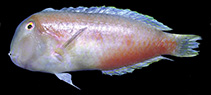
Espinhos dorsais (total) : 9; Raios dorsais (total) : 12; Espinhos anais: 3; Raios anais : 12; Vértebras: 25. This species is distinguished by the following characters: D IX,12; A III,12; pectoral rays 12; interrupted lateral line, 21 + 5 pored scales; cheek naked except for 3 rows of small scales below eye, first row of 7 scales curves to behind lower fourth of eye, second one straight with 6 scales, and the third row, 3 embedded scales; 2 small scales dorsoanteriorly on opercle, 1 embedded; scales absent basally on dorsal and anal fins; 17 gill rakers; body depth 3.3 in SL; body compressed, the width 2.6 in body depth; dentition generic; origin of dorsal fin above posterior edge of orbit; first 2 dorsal spines slender, flexible. the first spine slightly longer, 3.0 in head length (HL); third dorsal spine 4.8 in HL; space between first two dorsal spines 2.3 in space between second and third dorsal spines; membrane deeply notched between second and third spines; slightly rounded caudal fin is very short, 1.8 in HL; pelvic fins short, not approaching anus, 1.7 in HL; when fresh, greenish gray, scales below lateral line with a vertically elliptical violet spot, except for a broad bright red area above anal fin and ventral half of caudal peduncle; scales above lateral line with green edges and a faint red spot; anterior edge of head and nape blue; 2 vertical parallel violet lines from chin across lips and fading half distance to eye; median fins blue with yellow markings; pectoral fins translucent, except for black edges on upper three rays, the base violet, with two broad lavender-pink arcs around base; pelvic fins blue; iris yellow with a broad lavender-pink ring. Iniistius griffithsi differs from I. brevipinnis in having a more evenly convex dorsal profile of the head, a shorter suborbital, larger mouth, and its fifth and sixth dorsal and anal rays are the longest, 2.5-2.6 in HL (vs. penultimate rays longest, 3.0 in HL in I. brevipinnis) (Ref. 93522).
Body shape (shape guide): short and / or deep; Cross section: compressed.
Ciclo de vida ou comportamento de acasalamento
Maturidade | Reprodução | Desova | Ovos | Fecundidade | Larvas
Distinct pairing during breeding (Ref. 205).
Randall, J.E., 2013. Seven new species of labrid fishes (Coris, Iniistius, Macropharyngodon, Novaculops, and Pteragogus) from the Western Indian Ocean. J. Ocean Sci. Found. 7:1-43. (Ref. 93522)
Status na Lista Vermelha da UICN (Ref. 130435: Version 2025-2 (Global))
Ameaça para os humanos
Harmless
Uso pelos humanos
Pescarias: espécies comerciais
Ferramentas
Relatórios especiais
Baixar XML
Fontes da internet
Estimativas baseadas em modelos
Índice de diversidade filogenética (Ref.
82804): PD
50 = 0.5000 [Uniqueness, from 0.5 = low to 2.0 = high].
Bayesian length-weight: a=0.01995 (0.00906 - 0.04395), b=3.01 (2.83 - 3.19), in cm total length, based on all LWR estimates for this body shape (Ref.
93245).
Nível Trófico (Ref.
69278): 3.4 ±0.5 se; based on size and trophs of closest relatives
Resiliência (Ref.
120179): Elevada, tempo mínimo de duplicação da população menor que 15 meses (Preliminary K or Fecundity.).
Vulnerabilidade da pesca (Ref.
59153): Low vulnerability (10 of 100).
🛈