>
Perciformes/Serranoidei (Groupers) >
Serranidae (Sea basses: groupers and fairy basslets)
Etymology: Chelidoperca: Greek, chelidon, -onos = swift, as black as a swift + Greek, perke = perch (Ref. 45335); maculicauda: Name from the Latin, referring to the distinct grey spot on the tail.
Environnement : milieu / zone climatique / profondeur / gamme de distribution
Écologie
marin démersal; profondeur 180 - 320 m (Ref. 75235). Deep-water
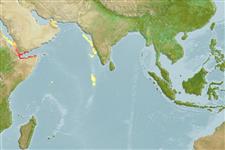
Indian Ocean: Arabian Sea. coast of southern India and off Somalia (Gulf of Aden) and Indonesia.
Taille / Poids / Âge
Maturité: Lm ? range ? - ? cm
Max length : 12.9 cm mâle / non sexé; (Ref. 75235)
Description synthétique
Clés d'identification | Morphologie | Morphométrie
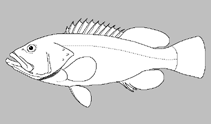
Épines dorsales (Total) : 10; Rayons mous dorsaux (Total) : 10; Épines anales: 3; Rayons mous anaux: 6; Vertèbres: 23. This species is distinguished by the following characters: D X,10; A III,6; pectoral-fin rays 15; lateral-line scales 42; gill rakers 3 + 9; caudal rays 17; 4th dorsal spine longest, 2.8 in HL; body depth 23.3% SL, 4.3 in SL; head length 40.3% SL; orbital length 9.3 in SL; 2.5-3 scales above lateral-line to dorsal origin; 40-46 serrae on margin of preopercle; dorsal fin continuous, with 9th dorsal spine shorter than tenth spine; longest dorsal soft ray (7th) 2.4 in HL; first anal-fin spine 8.7 in HL, second anal-fin spine 3.49 in HL; relatively short pelvic fin, 4 in SL; colour of head and body pinkish, ventral side pale; body with 6 white blotches; numerous small bluish white circular spots on lower caudal fin, upper caudal fin with a small circular grey spot distally (Ref. 75235).
Body shape (shape guide): elongated; Cross section: circular.
Cycle de vie et comportement reproducteur
Maturité | Reproduction | Frai | Œufs | Fécondité | Larves
Bineesh, K.K., K.V. Akhilesh, E.M. Abdussamad and N.G.K. Pillai, 2013. Chelidoperca maculicauda, a new species of perchlet (Teleostei: Serranidae) from the Arabian Sea. aqua, Int. J. Ichthyol. 19(2):71-78. (Ref. 75235)
Statut dans la liste rouge de l'IUCN (Ref. 130435: Version 2025-2 (Global))
Menace pour l'homme
Harmless
Utilisations par l'homme
Outils
Articles particuliers
Télécharger en XML
Sources Internet
Estimations basées sur des modèles
Indice de diversité phylogénétique (Réf.
82804): PD
50 = 0.5000 [Uniqueness, from 0.5 = low to 2.0 = high].
Bayesian length-weight: a=0.00525 (0.00208 - 0.01324), b=3.13 (2.92 - 3.34), in cm total length, based on LWR estimates for this (Sub)family-body shape (Ref.
93245).
Niveau trophique (Réf.
69278): 3.6 ±0.5 se; based on size and trophs of closest relatives
Résilience (Réf.
120179): Haut, temps minimum de doublement de population inférieur à 15 mois (Preliminary K or Fecundity.).
Vulnérabilité de la pêche (Ref.
59153): Low vulnerability (10 of 100).
🛈